Insikter & nyheter från Revea

With Community at the Core: Revea’s Growth Journey Continues

Revea has experienced impressive growth over the past year, building a strong team where company culture, community and job satisfaction are valued just as highly as financial performance – to create sustainable success.
2025-04-08
5 min read

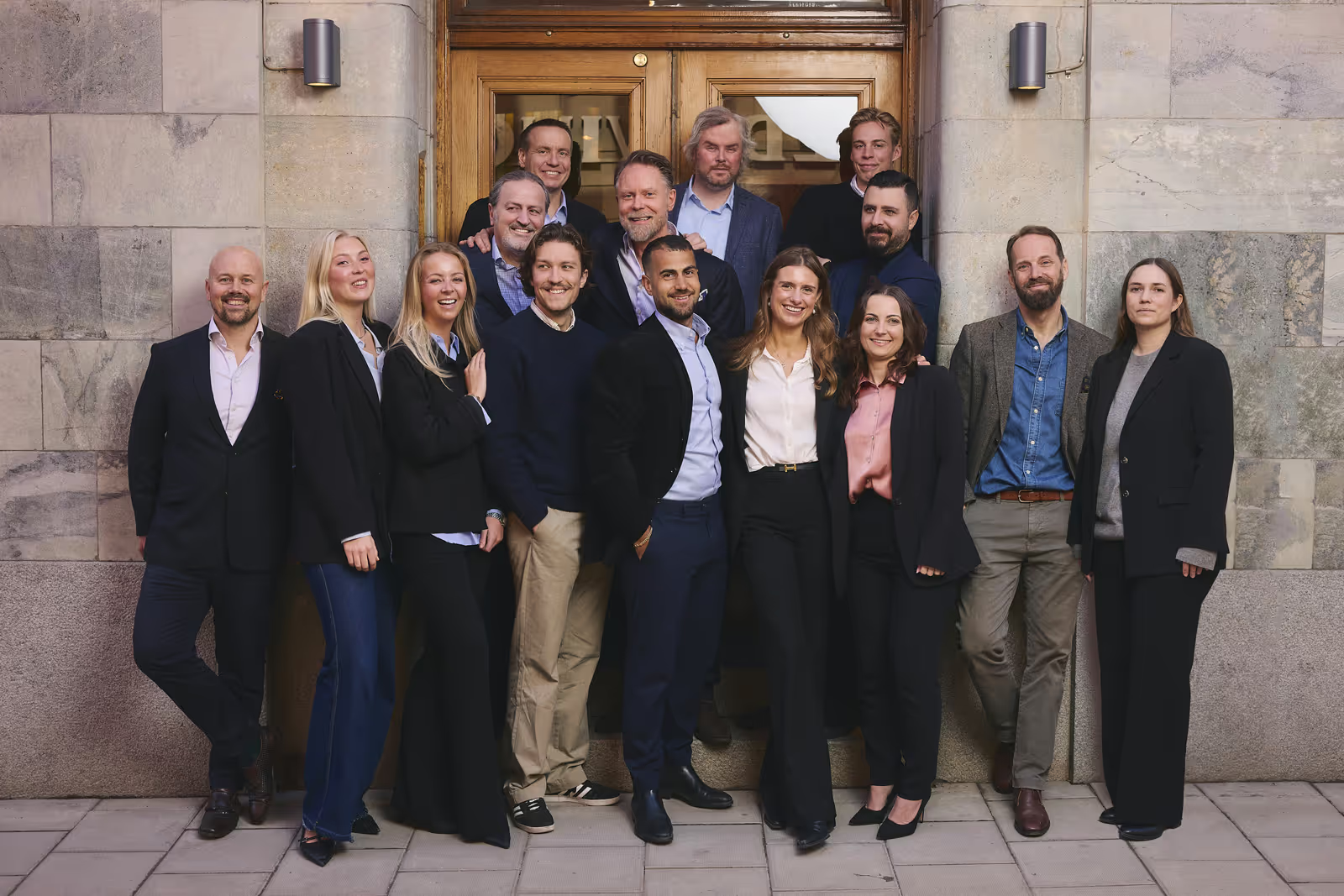
April is just around the corner, and as we at Revea look back at the past year, it’s with pride and gratitude. Our growth journey has been nothing short of exceptional. From a handful of dedicated colleagues at the end of last year, we’ve now grown into a fantastic and diverse team.

This expansion has been both exciting and challenging. But despite the rapid pace, we’ve never lost sight of what truly matters to us – our company culture. At Revea, we believe that real success is about much more than numbers on a page.

More Than Just Growth

To us, company culture, community, and job satisfaction are just as important as financial results. It’s this balance that creates the sustainable success we aim for. When employees thrive and feel valued, the business grows – something we’ve clearly seen over the past year.

We plan to continue our growth journey in the coming year, always with our unique culture at the heart of it. That’s how we build something that lasts.

Want to Join Our Journey?

Are you curious about where we’re headed next? Or maybe you’re the next talent to join our team? Visit our career page or reach out to us – we’d love to tell you more about the exciting opportunities at Revea!

We’re always looking for passionate people who share our values and want to help build something extraordinary.


Contact ReveA

Do you need help with ?

Revea helps a lot of business owners with . Do you also need some help? Fill out the form and we'll get back to you shortly.

Please fill in your contact details below and we will get back to you quickly to schedule an appointment.
Oh, thank you. We have received your message and will get back to you as soon as we have the opportunity.
Oops! Something went wrong while submitting the form.
2026-01-19
read time

Tax and innovation — how to use Sweden’s R&D tax relief (Forskningsavdrag) in 2026

Sweden’s Forskningsavdrag cuts employer contributions for R&D staff in 2026—lowering innovation costs with proper documentation.

Sweden is consistently ranked among the world’s most innovative economies. Technology, automation and new solutions are supported not only by the market, but also through the tax system. One of the most practical tools for companies working with research and development is the R&D tax relief called Forskningsavdrag.

In 2026, it remains one of the most effective ways to reduce the real cost of innovation — for both small companies and large groups.

What is Forskningsavdrag?

Forskningsavdrag is a tax relief that allows companies to reduce employer social security contributions for employees involved in R&D work. It is not a deduction from taxable profit — instead it reduces payroll-related charges, which often means a direct financial effect.

Key points at a glance

  • Employer contributions can be reduced by up to 19.59%
  • Maximum base of 3,000,000 SEK per month
  • Applies to employees working with R&D
  • Can also include work performed outside Sweden, as long as contributions are paid in Sweden

This is one of the more attractive payroll-based R&D incentives in Europe because it can improve cash flow without relying on grants.

Who can use the relief?

Forskningsavdrag can be used by commercial businesses regardless of size. Eligibility is based on the nature of the work, not the legal form.

Typical eligible businesses include:

  • Technology and manufacturing companies
  • Startups and scale-ups
  • Service companies running development projects
  • Businesses developing new products, processes, services or digital solutions

Both permanent employees and contracted individuals may be relevant — provided the work qualifies as R&D and social contributions are paid in Sweden.

What activities qualify as R&D in Sweden?

R&D can include, for example:

  • Creating new products, technologies or services
  • Software development and testing of new functionality
  • Improving production and technical processes
  • Designing prototypes and models
  • Technical or scientific investigations
  • Developing new analytical methods or tools

If a project requires creativity, specialist competence and introduces something new or a significant improvement, it will often fall within the R&D scope.

Conditions you must meet

To apply the relief, the company typically needs to meet these requirements:

  • The employee spends at least 50% of working time in that month on R&D activities
  • The employee must not turn 66 during the tax year
  • The project must have a commercial purpose
  • The company must be able to document the R&D work performed

Activities funded by public institutions do not qualify for the relief.

What does the financial benefit look like in practice?

Employer social security contributions in Sweden are 31.42%.

With Forskningsavdrag, they may be reduced to around 11.83%, which can mean savings of hundreds of thousands of SEK per year if you have several R&D employees.

The relief is particularly valuable for companies employing highly qualified specialists — engineers, analysts, developers, designers, and other technical roles tied to innovation.

Why should companies use the R&D tax relief?

  • Reduces the cost of running innovation projects
  • Improves competitiveness
  • Supports R&D financing without needing grants
  • Encourages development and technology growth in Sweden
  • Helps both domestic and international companies scale faster

Summary

Forskningsavdrag is one of Sweden’s most important tax tools for supporting innovation. Companies investing in research and development can significantly reduce payroll-related costs, making it easier to scale projects, hire experts and bring new technologies to market.

Revea supports companies with R&D tax relief and reporting

We can help you:

  • assess whether your projects qualify as R&D
  • prepare documentation for Skatteverket
  • apply Forskningsavdrag correctly
  • handle payroll cost reporting and ongoing compliance

Contact us if you want to make sure you’re using the relief in the most efficient and correct way:

08-678 18 40 or info@revea.se

2026-01-13
read time

Revea Redovisning AB Enters a New Phase

We are pleased to announce that Martin Krus has taken over as CEO of Revea Redvisning AB.

We are pleased to announce that Martin Krus has assumed the role of CEO at Revea Redovisning AB.

“I have long viewed Revea as a strong company with dedicated and competent employees. It feels great to now be part of the team,” says Martin Krus.

About Martin

Since 2002, Martin has worked with finance, accounting, and business development at a strategic level.

He founded KAM Redovisning AB and has over two decades of experience in leadership roles. With a background as an SRF-authorized accounting and payroll consultant, as well as a certified business advisor, Martin brings solid experience in business management. He has a deep understanding of how to develop and drive a company forward with a focus on structure, growth, and long-term business value.

Martin’s Vision for Revea

How do you view Revea’s role for its clients?
“A good accounting firm creates security and structure. When the foundation works, time and energy are freed up for decision-making, development, and doing business.”

How do you want to develop Revea as an organization?
“By building upon our people, culture, and clear working methods. That is how sustainable development is created over time.”

What is important going forward?
“Smart use of technology, combined with a close dialogue with our clients.”

We warmly welcome Martin to Revea and look forward to continuing our journey of development together.

2026-01-05
read time

Taxes on investments and capital in Sweden in 2026: ISK, K4, crypto, stock market and practical ways to reduce tax

How to navigate Swedish taxes on ISK, K4, crypto and capital gains in 2026 – and use legal strategies to reduce your overall tax burden.

Investing in Sweden is becoming increasingly popular – both among private individuals and entrepreneurs running businesses here. The Swedish tax system is considered one of the most transparent in Europe, while at the same time offering investors significant opportunities for optimisation. In practice, this means that the right choice of tools and investment structures can significantly reduce the tax you pay – and in some cases even eliminate it.

In this article, we explain how investments are taxed in Sweden – from ISK accounts and the K4 form to cryptocurrencies and corporate capital gains – and how to legally and effectively reduce your tax burden.

ISK – the account that changed investing in Sweden

The most popular way to invest in Sweden is through the Investeringssparkonto (ISK), an investment savings account designed for simple, long-term investing. This solution is particularly attractive for people who want to invest without complicated paperwork and annual tax reporting.

With an ISK, you do not pay tax on your actual profit – neither on capital gains from selling shares nor on dividends. Instead, a small schablon tax (standardised, notional tax) is calculated on the value of the portfolio. In practice, this is often lower than the traditional 30% capital gains tax.

Why is ISK so beneficial?

Because in most cases it allows you to invest without worrying about detailed reporting, and it protects investors from paying high tax in years when they realise unusually large gains.

This is one of the main reasons why more than 5 million people in Sweden now have an ISK account.

K4 – mandatory for investors outside ISK

Not all investments can be held in an ISK. Investors who trade via ordinary brokerage accounts, use foreign platforms (such as Degiro, eToro, Interactive Brokers) or invest in cryptocurrencies must report their transactions in the K4 form.

This is where you report:

  • sales of shares and funds
  • transactions in derivatives
  • cryptocurrencies
  • gains and losses from trading on foreign exchanges

All realised gains are taxed at 30%, and any losses can reduce the taxable base (within certain limits).

The most common challenge? Collecting transaction data. For cryptocurrencies or active day trading, the number of transactions can reach hundreds or thousands. As a result, more and more investors choose to have their K4 prepared by professional accounting firms.

Cryptocurrencies in Sweden – taxation without secrets

The Swedish Tax Agency (Skatteverket) has for years been clear on how it views cryptocurrencies: they are capital assets, not currency.

This means that every sale, swap or use of crypto to pay for goods or services is a taxable event.

The key rules are:

  • gains are taxed at 30%
  • every transaction must be reported in the K4 form
  • losses can be deducted, but not as fully as for shares
  • buying crypto is not taxed – tax arises only when you sell or exchange

There is currently no possibility to hold cryptocurrencies inside an ISK.

In practice, this means greater responsibility for the investor and a strong need for accurate and detailed documentation.

Dividends in Sweden – 30% tax, but not always

The standard tax rate on dividends in Sweden, the so-called Kupongskatt, is 30%.

This applies to both individuals and foreign entities.

The good news is that for investors outside Sweden, this withholding tax can often be reduced through double taxation treaties – for example to 15% for Polish tax residents.

Dividend payments within an ISK do not require any additional reporting and are not included in the K4 form.

Selling a company and capital gains – when can you avoid tax in Sweden?

Corporate capital gains in Sweden are generally taxed at 20.6%. This includes, for example, gains from the sale of shares or business interests.

However, the Swedish system offers an important exception – and this is one of the most efficient tax optimisation tools in the entire EU.

If the sold shares qualify as “kwalificerade andelar” (qualified shares) and the company is a Swedish tax resident, it may be possible to achieve full exemption from capital gains tax.

The condition?

The proceeds must be used for business-related purposes – in practice, they need to be reinvested.

This is why many Swedish tech companies and holding structures use this mechanism when selling subsidiaries or restructuring groups of companies.

How to legally reduce tax on investments in Sweden – key strategies

There is no single universal solution, but there are several strategies that are widely used in practice:

  1. Choosing the right investment account (ISK vs ordinary account)
  2. The simplest and most common way. ISK removes tax on capital gains and dividends and replaces it with a relatively low standardised tax on the portfolio value.
  3. Using capital losses in the K4 form
  4. Properly reporting and offsetting losses can reduce your annual tax bill by several thousand or even tens of thousands of SEK.
  5. Holding companies – selling a business tax-free
  6. For entrepreneurs, a Swedish holding structure can be one of the most powerful optimisation tools, especially in connection with the sale of companies or shares.
  7. Reducing tax on foreign dividends
  8. Thanks to tax treaties, the withholding tax charged abroad can often be reduced and partly credited in Sweden.
  9. Strategic investment planning
  10. The choice of investment products and platforms also affects how and where your returns are taxed. Being aware of the differences between ISK, ordinary accounts and corporate solutions is crucial.

Poland – Sweden: how does double taxation work?

There is a double taxation treaty between Poland and Sweden that protects investors from being taxed twice on the same income.

In principle, income is taxed in the country where it arises, and then offset mechanisms ensure that you do not pay tax twice on the same amount.

This is particularly important for:

  • Polish entrepreneurs operating in Sweden
  • investors from Poland earning returns on the Swedish stock market
  • people moving between the two countries

When should you seek help from a tax advisor?

The more complex your investments, the higher the risk of mistakes.

Professional support is especially valuable when you:

  • invest through several platforms at the same time
  • trade or hold cryptocurrencies
  • own a company or a holding structure
  • plan to sell shares in a business
  • want to minimise your tax burden within the boundaries of the law

Having an expert prepare your K4 or advise on the structure of your investments can often save tens of thousands of SEK – and in corporate transactions, sometimes much more.

Need help with reporting investments, K4 or tax planning?

At Revea, we support investors, entrepreneurs and private individuals with:

  • tax returns and reporting
  • optimisation of investment structures
  • holding and group structures
  • taxation of cryptocurrencies
  • cross-border tax advice between Poland and Sweden

Get in touch with us – we’ll help you choose the solutions best suited to your situation and plans.

2025-12-17
read time

Property Tax in Sweden – How Property Value and Tax Are Calculated

Learn how property tax is calculated in Sweden and what rates apply for 2025.

In Sweden, property owners pay an annual tax based on the type, value and location of the property.

For 2025, the rates are set centrally by Skatteverket, but they vary depending on the type of property.

How Property Value Is Calculated

The property tax is based on the tax assessment value (taxeringsvärde), which is updated every few years by Skatteverket.

This value generally corresponds to around 75% of the property’s market value.

The following factors are considered:

  • the size of the building and plot,
  • the location,
  • the year of construction and technical standard.

Property Tax Rates in 2025

Single-family houses (småhus)

  • Tax rate: 0.75% of the assessed value.
  • Maximum tax amount: SEK 9,287 per year (2025 limit).

Cooperative apartments (bostadsrätt)

  • Individual apartment owners do not pay property tax directly.
  • The housing association pays property tax on the collectively owned property.

Commercial buildings

  • Tax rate: 1%–1.3% of the assessed value.

Vacant land

  • Tax rate: 1% of the land value.

Newly Built Properties

New houses and residential buildings are exempt from property tax for the first 15 years after construction.

The exemption is applied automatically once the property is registered with Skatteverket.

Deadlines and Payment

Property tax is collected by Skatteverket as part of the annual tax settlement.

Information about the amount due appears in the taxpayer’s account on Mina sidor.

The tax can be paid in one instalment or in four instalments throughout the year.

Selling Property – Capital Gains Tax

When selling property in Sweden, a capital gains tax of 22% applies to the profit from the sale.

The gain is calculated as the difference between the selling price and the purchase cost, including improvement and renovation expenses.

Property Tax in Sweden – Key Takeaways

Sweden’s property tax system is relatively straightforward but requires an understanding of how assessment values and tax rates differ for each type of property.

Knowing these principles helps property owners avoid errors and plan their finances more effectively.

Revea assists property owners in analysing costs, reporting property-related taxes and preparing the necessary documentation for annual declarations.

2025-12-10
read time

Taxes in Sweden for Freelancers and the Self-Employed

Learn how freelancers in Sweden pay taxes and what deductions and rules apply in 2025.

Sweden is a business-friendly country for self-employed professionals, but running your own business comes with certain tax and administrative responsibilities.

To avoid mistakes and unnecessary costs, it’s important to understand the main tax rules for freelancers in 2025.

Registering a Business in Sweden

Anyone working on a self-employed basis must register their business with Skatteverket (the Swedish Tax Agency) and obtain:

  • an F-skatt number (entrepreneur’s tax ID),
  • a VAT number, if providing goods or services subject to VAT.

Registration allows freelancers to pay their own taxes and social contributions, and to issue invoices to clients.

Preliminary Tax and Annual Returns

Freelancers pay income tax in the form of monthly advance payments (preliminärskatt).

The amount depends on the expected annual income reported to Skatteverket.

At the end of the tax year, you must submit an annual tax return (Inkomstdeklaration 1 or NE attachment) to reconcile the final tax amount.

Contributions and Business Expenses

Self-employed individuals in Sweden are required to pay:

  • income tax – around 30–33%, depending on the municipality,
  • social security contributions (egenavgifter) – approximately 28.97% of income,
  • VAT (moms) – 25%, 12%, or 6%, depending on the industry.

Operating expenses such as equipment, software, travel, or marketing costs can be deducted from taxable income.

Tax Deductions for Freelancers

Freelancers are entitled to the same deductions as other taxpayers, including:

  • reseavdrag – travel deductions for client visits,
  • deductions for office, equipment and internet costs,
  • depreciation of assets worth more than SEK 25,000,
  • accounting and business software expenses.

Deadlines and Tax Responsibilities

The deadline for filing the 2024 tax return is 2 May 2025, and for 2025 – early May 2026.

All declarations and payments are handled online through Skatteverket’s Mina sidor portal.

Late payments may result in interest and additional fees, so keeping track of deadlines and balances is essential.

Freelancing in Sweden – Key Takeaways

Working as a freelancer in Sweden offers flexibility and independence – but also demands good organisation and awareness of tax obligations.

Understanding tax rules, rates and deductions helps you optimise your income and avoid costly errors.

Revea supports freelancers and self-employed professionals with accounting, reporting and tax planning, ensuring your business runs smoothly and in compliance with Swedish law.

2025-12-03
read time

Investment Tax in Sweden – How to Calculate Capital Gains Tax

Learn how capital gains are taxed in Sweden and what the 2025 rates mean for investors.

Investing in Sweden can be highly profitable, but it requires an understanding of how capital gains are taxed.

The Swedish tax system distinguishes several types of capital income, including profits from the sale of shares, investment funds and property, as well as bank interest and dividends.

What Does Capital Gain Mean in Practice?

A capital gain (kapitalvinst) arises when the sale price of an asset exceeds its purchase price.

This applies to:

  • shares and company holdings,
  • units in investment funds,
  • property or shares in property,
  • other financial investments.

Capital gains tax in Sweden applies to both private individuals and businesses.

Capital Gains Tax Rates in 2025

Sweden applies a flat 30% tax rate on most types of capital income, including:

  • profits from the sale of shares and funds,
  • bank interest,
  • dividends.

If you make a loss, it can be partly deducted:

  • 70% of the loss can be offset as an expense,
  • losses on shares or funds can only be deducted against the same type of asset.

Tax on Property Sales

The sale of property in Sweden also generates capital income.

The tax is calculated as 22% of the gain (which corresponds to 30% of two-thirds of the profit under Swedish tax rules).

Deductible expenses include:

  • purchase costs of the property,
  • renovations and improvements that increase its value,
  • notary fees and brokerage commissions.

Tax on Foreign Investments

Individuals who live in Sweden and have tax residency status must declare all foreign investments and pay capital income tax on their worldwide income.

To avoid double taxation, Sweden has signed tax treaties with many countries – including Poland.

Declaration and Payment of Tax

Capital gains tax is reported in the annual income tax return submitted to Skatteverket.

For the sale of shares, funds or property, all relevant information can be entered through Mina sidor (My Pages).

Skatteverket automatically calculates the amount of tax payable based on the data provided.

Investment Tax in Sweden – Key Takeaways

Understanding how investments are taxed in Sweden helps you avoid mistakes and unnecessary costs.

With proper planning, you can optimise your tax situation and even obtain a partial refund.

If you invest in Sweden or abroad, Revea can assist you in analysing capital gains, accounting for losses and preparing a compliant tax declaration.

2025-11-26
read time

Tax Deductions in Sweden – How the Swedish Tax System Helps You Save Money

Learn which tax deductions apply in Sweden in 2025 and how to use them to legally reduce your taxes.

Sweden is known for its high taxes – but also for its extensive system of tax deductions.

In practice, this means that even people with moderate incomes can significantly reduce their tax burden, provided they know when and how to use the available deductions.

Below you’ll find an overview of the most important tax deductions in Sweden that are worth considering in your 2025 tax return.

When Are You Entitled to Tax Deductions?

You can claim deductions if you:

  • are taxed under the ordinary income tax rules (not the 25% SINK tax),
  • earn at least 90% of your income in Sweden,
  • have proof of expenses, such as receipts, tickets, or contracts.

Individuals who stay in Sweden for less than six months are usually subject to SINK tax and therefore cannot claim deductions.

Main Tax Deductions in Sweden (2025)

Reseavdrag – Work Travel Deduction

You can deduct commuting expenses between your home and workplace if your annual costs exceed SEK 11,000.

This applies to both fuel and public transport costs.

Dubbel bosättning – Double Household Deduction

For individuals who maintain housing both in Sweden and in their home country.

You can deduct rental costs, travel expenses, and meal costs related to your stay in Sweden.

Tillfälligt arbete – Temporary Work Deduction

Applies to employees who work temporarily in a different location than their permanent residence.

You can deduct accommodation and travel expenses, according to the fixed rates set by Skatteverket.

Expertskatt – Expert Tax Relief

For foreign specialists and executives: a tax reduction of up to 25% of salary for up to five years, provided that the application is submitted to Forskarskattenämnden within three months of starting work.

How to Claim Tax Deductions in Sweden

  1. Prepare all expense documentation (receipts, tickets, contracts).
  2. Log in to Skatteverket and complete your income tax return.
  3. Enter the relevant deductions in the annual declaration form.
  4. Submit your tax return on time – no later than early May 2026.

Why Use Tax Deductions?

Tax deductions in Sweden are a real opportunity to save money – especially for people working away from home or maintaining two households.

Understanding the rules and applying them correctly helps you avoid errors and may result in a tax refund.

If you’re unsure which deductions apply to you, Revea can help you assess your situation and prepare an accurate tax return that includes all relevant deductions.

2025-11-15
read time

Swedish Tax Deductions 2025 – How to Legally Reduce Your Tax

Discover which tax deductions apply in Sweden in 2025 and how to legally reduce your taxable income.

The Swedish tax system is transparent but complex.

High tax rates do not necessarily mean a heavy tax burden.

Thanks to various tax deductions in Sweden, you can legally lower your taxable income and recover some of the costs related to your work.

This article explains the main Swedish tax deductions for 2025, eligibility rules, and common mistakes made by taxpayers.

Who Can Benefit from Tax Deductions in Sweden?

Tax deductions are available to people who:

  • are tax residents in Sweden, or
  • have chosen to be taxed under the ordinary income tax rules (instead of the simplified 25% SINK tax).

In practice, most deductions apply to individuals who live and work in Sweden for at least six months per year or have their centre of vital interests in Sweden.

Most Common Tax Deductions in Sweden (2025)

1. Work Travel Deduction – Reseavdrag

  • You can deduct commuting expenses if your total annual travel costs exceed SEK 11,000.
  • The distance between home and work must be at least 5 km.
  • Car travel is deductible only if it saves at least 2 hours per day compared with public transport.
  • More information: Skatteverket – Reseavdrag

2. Deduction for Double Households – Dubbel bosättning

Applies to individuals who work in Sweden but maintain housing in another country (for example, in Poland).

You can deduct:

  • accommodation costs in Sweden,
  • travel expenses to your home country,
  • meal expenses (for the first 30 days).

3. Temporary Work Deduction – Tillfälligt arbete

Applies to those working temporarily away from their permanent residence.

You can deduct transport, accommodation and meal expenses based on the fixed rates set by Skatteverket.

4. Expert Tax Relief – Expertskatt

A tax reduction of up to 25% of salary for up to five years for foreign experts and executives.

Applications must be submitted to Forskarskattenämnden within three months of starting work.

More information: Skatteverket – Expertskatt

How to Apply for Tax Deductions in Sweden

  1. Log in to Mina sidor on Skatteverket’s website.
  2. Complete your annual income tax return (Inkomstdeklaration 1).
  3. Enter the applicable deductions: reseavdrag, dubbel bosättning, etc.
  4. Attach supporting documentation (receipts, invoices, tickets).
  5. Submit your declaration by early May 2026.

Why Use Tax Deductions?

Tax deductions in Sweden are a legal and effective way to reduce your tax burden.

The right deductions can lead to significant savings – especially for those working temporarily or maintaining two residences.

If you are unsure which deductions apply to you, it may be worth consulting a tax expert.

Revea can assist you in identifying eligible deductions and preparing a correct and complete tax return.

2025-11-05
read time

Tax Residency in Sweden – How to File Taxes in 2025

Find out who qualifies as a tax resident in Sweden, how the SINK tax works for non-residents, and what obligations entrepreneurs have. Learn about the updated 2025 tax rules and how to avoid mistakes when filing with the Swedish Tax Agency (Skatteverket).

Tax Liability in Sweden – The Basics

In Sweden, everyone who earns income in the country is subject to taxation – regardless of whether they are self-employed or employed.

How and where you pay tax depends on your tax residency status – whether you are considered a resident or a non-resident for tax purposes.

Who Qualifies as a Tax Resident in Sweden?

According to Skatteverket, a person becomes a tax resident in Sweden if they meet at least one of the following conditions:

  • They have a permanent home in Sweden.
  • They stay in Sweden continuously for at least six months.
  • They have strong personal or economic ties to Sweden – such as family, a home, a business, or a stable source of income.

Those who do not meet these criteria are subject to limited tax liability and may pay tax under a simplified system known as the SINK tax (Special Income Tax for Non-Residents).

The SINK Tax in Sweden – For Whom and How It Works

SINK is a flat-rate income tax for individuals working in Sweden on a temporary basis – for example, seasonal work, remote work, or short-term assignments.

  • The SINK rate is 25%, deducted directly from gross income.
  • There is no requirement to file an annual tax return.
  • No deductions or allowances are permitted under SINK.

However, a non-resident can opt out of SINK and choose the standard income tax system instead. In that case, they file taxes as a Swedish tax resident and may claim deductions and potential refunds.

Income Tax for Tax Residents in Sweden

Individuals with unlimited tax liability (residents) must declare and pay tax on worldwide income – income earned both in Sweden and abroad.

Swedish residents pay two main types of income tax:

  • Municipal tax (kommunalskatt) – set by the local municipality, averaging around 32%.
  • State income tax (statlig skatt) – applies to income above approximately SEK 613,900 per year (in 2025).

VAT and Business Taxes in Sweden

Entrepreneurs operating in Sweden must register with Skatteverket and regularly report and pay taxes, including:

  • VAT (moms) – 25%, 12%, or 6%, depending on the goods or services provided.
  • Business income tax.
  • Employer’s social security contributions (arbetsgivaravgifter) – if employees are hired.

Businesses must also maintain proper bookkeeping and documentation in accordance with Swedish tax law.

The Five-Year Rule for Former Swedish Residents

A person who has been a Swedish tax resident for an extended period may still be considered a Swedish tax resident for up to five years after leaving the country, if Skatteverket determines that they maintain significant ties to Sweden – such as property ownership, family, or an ongoing business.

Tax Resident or Non-Resident – Which Is Better?

Whether it is more beneficial to be a tax resident or non-resident in Sweden depends on your situation.

Short-term workers often benefit from the simplicity of the SINK system, while long-term employees, business owners, and permanent residents usually gain more by being taxed as residents – gaining access to deductions, tax credits, and social benefits.

Before deciding on your tax status, it is always best to consult a professional advisor.

Contact Revea – we can help you determine which option is most advantageous for you: +46 (0)8 678 18 40info@revea.se

Why Tax Residency Matters in Sweden

Your tax residency status in Sweden determines where and how you pay taxes.

Understanding the rules on SINK tax, residency, and current tax rates will help you avoid mistakes and penalties from Skatteverket.

Strategic tax planning is the foundation of safe and sustainable business operations in Sweden.

Want to know more about Swedish taxation, VAT, or company registration?

Contact us via revea.se/contact – our experts will guide you through every step of your tax and business process in Sweden.