Insights & news from Revea
Here you will find news and insights about us, the industry and the wider economy.

AGI Sweden – A Key Obligation When Posting Workers in 2026
What is AGI and who does it apply to?
AGI Sweden (Arbetsgivardeklaration på individnivå) is a monthly employer declaration filed at the individual level. Instead of reporting a combined tax amount for your entire workforce, you itemise the salary, tax deduction and employer contributions for each employee separately.
In the context of posting workers, the obligation to file AGI arises when your company has registered as an employer in Sweden, when you employ workers subject to Swedish tax obligations (e.g. SINK tax), or when there is a so-called economic employer – a key concept for foreign companies.
The Economic Employer trap (Ekonomiskt arbetsgivare)
Just a few years ago, the 183-day rule allowed companies to avoid paying taxes in Sweden on short contracts. In 2026, the rules are significantly tighter. If your employees perform work for a Swedish entity that directly benefits from their services, Swedish tax authorities may treat that Swedish company as the actual employer – even if the formal employment contract is with your Polish company. The tax obligation then arises from the very first day of work.
SINK vs A-SINK vs Full taxation
- SINK: flat 25% on gross salary, no deductions. Best for short assignments.
- A-SINK: flat 15%, applies to artists and athletes only.
- Full taxation: applies when workers have unlimited tax liability in Sweden. Full employer social contributions apply.
How to file AGI in Sweden
The process is entirely digital and requires a Swedish BankID or an authorisation for an accounting firm. The declaration must be filed by the 12th of the month following payment of wages. You must report exact salary amounts, benefit values (e.g. accommodation, meals), and the tax withheld. Corrections are allowed, but frequent amendments may trigger a tax audit.
Common mistakes by Polish companies
Missing coordination numbers
Without a Samordningsnummer for each worker, filing a correct AGI is very difficult. Skatteverket may reject the declaration or require complex manual procedures. Apply for coordination numbers early.
Failing to report benefits
Sweden strictly taxes non-monetary benefits. Accommodation provided to workers must be valued at market or standard Skatteverket rates. Failing to declare this results in surcharges and penalty interest.
Inconsistency with ID06
On larger construction sites, ID06 records actual worker attendance. Inspectors cross-check ID06 logs against AGI declarations. If a worker was on site for a full month but only appears in AGI for two weeks, expect an audit request.
Summary
AGI Sweden is proof to the Swedish authorities that your company operates lawfully. Errors can result in automatic late-filing fees (förseningsavgift), blocked ID06 cards for your workers, and payment problems with clients who bear joint liability for your taxes.
At Revea, we specialise in AGI procedures for companies posting workers to Sweden. Contact us to ensure full compliance with Swedish law in 2026.

Company in Sweden – Start-up and Running Costs in 2026
The myth that Sweden is an expensive country for entrepreneurs often stems from a misunderstanding of its system. Yes, taxes are high – but the costs of running a company in Sweden are predictable, and bureaucracy is kept to a minimum. In 2026, thanks to the full digitalisation of dealings with authorities, many administrative fees (such as stamp duties or postal costs) are a thing of the past.
How much do you realistically need to invest to open a business across the Baltic? We break down the costs, analysing the different types of business activity available in Sweden.
1. Choosing a legal form and start-up capital
Your first expense depends on the structure you want to operate under. Swedish law offers several options, the most popular being the sole trader (Enskild firma) and the limited company (Aktiebolag).
Sole trader (Enskild firma)
This is the cheapest option to get started. Importantly, it requires no start-up capital. Registration with the Swedish Companies Registration Office (Bolagsverket) is often optional (costing around 1,000–1,500 SEK), and the registration itself with the tax authority is free of charge.
Limited company (Aktiebolag)
If you want to separate your personal assets from your business assets, you choose the limited company – Aktiebolag.
The share capital requirement in 2026 remains a minimum of 25,000 SEK. Importantly, this money is not lost. You can use it for current business expenses immediately after registration.
The registration fee is a one-off cost at Bolagsverket of approximately 1,900 SEK (when registering online).
2. Fixed costs – taxes and social contributions
Once you register, you enter into a relationship with Skatteverket. Regardless of your legal structure, you need to account for monthly obligations.
F-skatt (income tax and contributions) – the business owner pays their own contributions. The total burden (municipal tax + social insurance) is typically around 40–50% of net income.
VAT – The standard VAT rate in Sweden is 25%. There are, however, reduced rates: 12% (e.g. food, hotels) and 6% (books, passenger transport). You file monthly, quarterly or annually – depending on your turnover.
Social insurance (Försäkringskassan)
As a business owner, you are responsible for your own social security. The company owner registers with the Swedish Social Insurance Agency Försäkringskassan to become entitled to sickness and parental benefits. Contributions for these benefits are already included in the so-called Egenavgifter (part of F-skatt), which amount to approximately 28.97% of income.
3. Foreign company in Sweden – specific costs
Many foreign entrepreneurs do not set up a new company but instead register a branch or operate as a foreign entity (utländsk företagare).
In that case, you must submit a completed application for foreign entrepreneurs (form SKV 4632). The procedure itself is free, but gathering the required documents comes at a cost:
- A certificate of no arrears with ZUS (Polish social insurance) – required when applying for F-skatt.
- Sworn translations of the company’s registration documents (KRS extract).
For companies from the European Union and the European Economic Area, the process is simplified, but still requires correspondence with the authority. The main contact address for foreign companies is: Swedish Tax Agency, Skatteverket Utlandsskattekontoret, SE-205 31 Malmö.
Cost overview
To help you make an informed decision, we have prepared a simple summary of estimated costs (figures for 2026):
Costs you need to be aware of
When planning your budget, do not forget about operational expenses that are specific to the Swedish market:
- ID06 cards – if you work in construction, every worker must hold a card (cost of a few hundred kronor + an annual company fee).
- Bank account – opening an account for a company with foreign capital can be difficult and costly in Sweden. Banks require a personal visit and a range of AML (Anti-Money Laundering) documents.
- Correspondence address – authorities send correspondence by post. If you do not have an office, you will need to rent a mailbox or virtual office service, which generates a fixed monthly cost. Remember to provide proof of a branch address in Malmö or another delivery address in Sweden if the authority requests it.
Summary
The answer to “how much does a company in Sweden cost?” depends on the scale of your activity. For a self-employed person (consultant, developer), the entry costs are nearly zero. For a construction company, there are investments in certificates and administration. The most expensive things in Sweden, however, are mistakes. Failing to file a declaration on time, miscalculating VAT, or failing to register in the correct register results in fines running into thousands of kronor.
At Revea, we make sure your costs of running a company in Sweden are limited to the essentials. We assist with company registration (Aktiebolag), setting up branches and ongoing accounting, guaranteeing compliance with 2026 regulations. Contact us – we will draw up your start-up cost estimate free of charge.

Posting Workers to Sweden – A Guide to Obligations in 2026
For many Polish companies, expanding northward is a natural direction of growth. Geographic proximity and a receptive market have made posting workers to Sweden an everyday reality in the construction, IT and assembly industries. However, in 2026, simply holding an A1 form from the Polish ZUS is no longer enough.
Sweden, protecting its labour market, imposes a range of administrative obligations on companies posting workers. Ignoring them risks not only heavy fines, but also work stoppages enforced by trade unions. So how do you legally send your workforce to Sweden?
What does posting workers mean under the law?
We speak of posting workers when a Polish employer sends an employee to another country to provide services for a defined period of time. The key point is that the worker does not relocate permanently – they are simply completing a specific assignment.
These rules stem from directives applicable across EU member states, but each country implements them somewhat differently. In Sweden, the system is closely monitored for signs of social dumping.
Registration with Arbetsmiljöverket
This is the absolute foundation. Every foreign company that posts personnel – even for just a few days – is required to notify the Swedish Work Environment Authority (Arbetsmiljöverket).
The notification must be submitted before work begins. You will need to provide:
- Company details and the name of a contact person in Sweden (a representative).
- The location where the services will be performed.
- The period of posting.
- Details of the workers.
Failing to submit this notification almost certainly results in a financial penalty if an inspection takes place.
Pay and collective agreements (Kollektivavtal)
This is where Polish companies most commonly make mistakes. Sweden does not have a single statutory minimum wage. Pay conditions are regulated by collective agreements for individual sectors.
This means that when posting a worker, you must guarantee them conditions no less favourable than those required under Swedish law and sector-specific agreements. This covers:
- The minimum hourly rate (in line with the relevant sector).
- Working hours and rest periods.
- Annual leave entitlement.
Depending on the sector (e.g. construction vs cleaning), Swedish trade unions such as Byggnads may require you to sign a so-called accession agreement. If you refuse, they have the right to blockade the worksite.
Health and Safety (BHP)
Swedes take safety seriously – and rightly so. Workers posted to Sweden must work in accordance with local health and safety standards.
As the employer, you are responsible for the working environment. This means providing appropriate protective equipment, training, and – in the case of construction – ensuring workers hold ID06 cards.
Key obligations – a cheat sheet for employers
To help you navigate the essentials of posting workers, we have prepared a table with the most important deadlines and requirements.
Posting workers and taxes in 2026
It is worth bearing in mind the concept of the "economic employer", which has been in force in Sweden for several years. If your workers carry out work in Sweden under the direction of a Swedish client and are integrated into that client's organisation, a tax obligation may arise from the very first day of work – regardless of the 183-day rule. This requires registering your company with Skatteverket and making advance tax payments.
Summary
Legally posting workers to Sweden requires precision and a solid understanding of local conditions. The Swedish rules themselves are transparent, but rigorously enforced. Attempts to circumvent registration requirements or undercut wage rates typically end in costly sanctions and damage to your reputation in the Scandinavian market.
You do not need to know every nuance of the cross-border service regulations yourself. At Revea, this is what we do every day. We will help you register your workers with Arbetsmiljöverket, verify that your contracts meet collective agreement requirements, and ensure your tax reporting is accurate. Contact us to grow your business safely across the Baltic.

Trade Union Inspection in Sweden – How to Pass an Audit in 2026
The Swedish labour market model differs fundamentally from systems familiar in Central Europe. Here it is not the labour code but collectively negotiated agreements that set the rules. For Polish entrepreneurs – especially in the construction and assembly sectors – a trade union inspection in Sweden is one of the most stressful aspects of doing business across the Baltic. In 2026, these audits have become even more detailed, and the digitalisation of time-tracking systems (ID06) gives unions powerful verification tools.
The role of collective agreements (Kollektivavtal)
Sweden has no statutory minimum wage. Collective agreements serve as the regulator. Signing an agreement with the relevant union (e.g. Byggnads for construction) is often a prerequisite for entering a construction site as a subcontractor. By signing a collective agreement, the company commits to upholding local standards – but at the same time opens the door to union inspectors.
The trade union organisation has the right to examine payroll documentation to ensure that workers employed by a foreign entity are not being exploited and are not undercutting market rates (so-called social dumping).
What exactly do inspectors check?
When an audit takes place, inspectors focus on several critical areas. The table below shows the most common flashpoints during an inspection compared to Polish standards:
1. Verification of hourly rates and job classification
The most common mistake made by Polish companies is paying workers the minimum rate for the lowest classification group while they are carrying out specialist work. Unions verify the qualifications of construction workers. If a worker holds a Swedish professional certificate (Yrkesbevis), they must receive the full rate. Workers receive back-pay if an inspection identifies irregularities.
2. Working hours and overtime
Swedes are extremely sensitive when it comes to the working environment and work-life balance. The standard is 40 hours per week. Every hour beyond this limit must be properly recorded. A frequent issue is exceeding the permitted number of hours within a calendar year. Electronic systems on construction sites log every entry and exit, making it practically impossible to conceal overtime in 2026.
3. Contracts and documentation
Every worker must have written information about their terms of employment. Employment contracts should be translated or drawn up in a language the worker understands, but must refer to Swedish conditions if the posting is long-term. Inspectors also check procedures in the event of illness – specifically whether the worker receives sjuklön (employer-paid sick pay) from day 2 to day 14 of illness.
Consequences of non-cooperation
Ignoring union demands or “creative accounting” is a short-sighted strategy. Trade unions in Sweden have the right to impose a blockade on a company (a construction site blockade), which in practice ends its activity in that market. Even if an employer says “I have already terminated the contracts with those workers”, the financial obligations arising from the period during which work was performed remain enforceable.
For Polish workers in Sweden, the presence of a strong union is a guarantee of security – but for the employer, it means the necessity of running a flawless HR and payroll administration.
How to prepare for an inspection?
To pass a trade union inspection in Sweden without financial penalties (which can run into hundreds of thousands of kronor), you must:
- Keep accurate time-tracking records consistent with ID06 data.
- Register all workers with FORA insurance (if required by the collective agreement).
- Ensure that total remuneration (gross + allowances) is no lower than stipulated in the collective agreement.
- Have organised documentation at the place where services are performed.
Summary
Sweden is a market of great opportunities, but also of strict rules. Going it alone against the machinery of union bureaucracy (such as Byggnads or IF Metall) carries enormous risk. In 2026, errors in payroll calculations, missing FORA insurance or a lack of familiarity with the nuances of collective agreements can cost a company not only its reputation but also its financial stability.
You don’t have to risk fighting regulations on your own. Revea accounting office is your partner in safe expansion. We specialise in comprehensive support for Polish companies on the Swedish market, taking on the burden of dealings with authorities and trade unions. We will ensure your documentation is always audit-ready and your employee settlements comply with the latest guidelines.

ID06 Sweden – The Most Important Information in 2026
If you are planning to carry out a contract in Scandinavia, there is one thing you need to know: without an ID06 card, your workers will not be allowed on site. In Sweden, this system is not optional – it is a market standard that tightens up the industry, prevents illegal employment and ensures safety.
In 2026, the regulations are even stricter than before, and the electronic ID is integrated with time-tracking systems. What exactly is this document, and how do you get through the registration process without a headache?
What is the ID06 system and who does it apply to?
Simply put, ID06 is a personal identification card. Everyone present on a construction site must have one – from manual workers and site managers to cleaning staff.
The card serves several functions:
- It opens turnstiles at the construction site.
- It records entry and exit times (an electronic attendance log that Skatteverket has access to).
- It confirms the identity and legal employment status of workers in the construction sector.
Not having a card, or using an invalid one, can result in severe financial penalties for the company and immediate removal from the site.
How to obtain a card? Step-by-step procedure
Before your workers can legally enter a construction site, the company must first be verified. The process in 2026 is fully digital, but it requires attention to detail – especially when verifying the identity of foreign nationals.
Identity verification – what to watch out for
The trickiest part is getting the worker correctly registered in the ID06 system. For the process to go smoothly, all employees must have valid identity documents.
For Polish citizens, a biometric passport works best for mobile verification (scanning the NFC chip with a phone). A Polish national ID card is also accepted, but the scanning process in the app can sometimes be more technically demanding than with a passport.
Remember that the data entered into the system must match the identity document exactly. A typo in a surname or an incorrect document expiry date will result in the application being rejected – and wasted time.
How much does it cost and how long does it take?
The cost of the card itself depends on the price list of your chosen provider (ID06 partner), but typically amounts to a few hundred Swedish kronor per card. On top of that, there is an annual administrative fee for the company registered in the system. The waiting time for physical cards is usually around 5 working days from the moment the worker’s identity is approved. It is therefore worth taking care of the formalities before the team leaves for Sweden.
Summary
ID06 Sweden is a term you need to add to your to-do list as soon as a contract is signed. The system is watertight and has no exceptions. If the formalities around posting workers, filing notifications with Swedish authorities or recording working hours seem complicated – you don’t have to do it alone. At Revea, we specialise in accounting and HR services for construction companies in Sweden. Contact us and we will help you navigate the maze of regulations, so you can focus on building.

F-tax Sweden (F-skatt) – Why Your Invoice Is Invalid Without It
When entering the Scandinavian market, many business owners focus on marketing and sales, treating administrative formalities as secondary. That is a mistake that in Sweden costs 30% of your revenue. If your Swedish client asks for your „F-skatt sedel” and you stare back blankly, the conversation about working together may come to a swift end.
In 2026, with tax systems being tightened and the Swedish Tax Agency Skatteverket increasingly digitalised, holding F-skatt status is the absolute foundation of doing B2B business in Sweden. What exactly is this document, how do you obtain it, and why do Polish companies so often struggle with it?
What is F-tax and why is it not actually a tax?
The name can be misleading. F-tax Sweden (Swedish: F-skatt) stands for Företagare skatt (business tax), but in practice it is not a new levy. It is a tax status certificate. Holding F-skatt sends a clear signal to your client: “I am a business owner. I handle my own taxes and contributions. You can pay me the full gross amount on the invoice.”
What happens when you do not have F-tax?
If you perform services in Sweden (e.g. construction, installation, IT) and are not registered for F-skatt, your Swedish client is legally required to treat you as an employee – even if you issue a VAT invoice.
Under the rules, they must then:
- Deduct 30% from your invoice as an advance income tax payment (withholding tax).
- Pay that money directly to Skatteverket.
- In many cases also pay social insurance contributions (approx. 31.42%).
For your company, this means a severe disruption to cash flow. Recovering the money through a tax refund procedure is possible, but takes months.
Who must – and who can – apply for F-skatt?
Any entity carrying out business activity in Sweden should apply for F-tax. This applies to sole traders and limited companies alike.
For a foreign company (e.g. a Polish construction firm), the key question is whether a so-called permanent establishment arises in Sweden. However, even if you do not have a fixed office there, if your employees spend a significant amount of time in Sweden, Swedish clients will require you to hold F-skatt for their own legal protection.
There are two main types of tax status, as illustrated in the table below:
Registering for F-skatt step by step in 2026
The registration process has been heavily digitalised in recent years, but for foreign entities it can still be challenging due to the lack of a Swedish bank identity (BankID).
1. Obtaining an organisational number
Before applying for F-tax, your company must obtain a Swedish identification number (organisationsnummer). For foreign companies, this number typically begins with the digit 5.
2. Submitting the application to Skatteverket
The actual F-skatt registration is done via the following forms:
- For Swedish companies: through the verksamt.se portal.
- For foreign companies: form SKV 4632 (“Tax application for foreign entrepreneurs”).
In the application you must estimate your future profit. This is a critical point. Based on your declaration, Skatteverket will calculate the amount of your monthly advance income tax payments (preliminärskatt).
3. Verification by the authority
Officials will check whether:
- You carry out gainful activity independently.
- You have no outstanding tax arrears in Poland (a certificate of no arrears is required).
- You have no history of financial crimes.
The waiting time for a decision in 2026 is typically between 2 and 6 weeks, depending on the workload of the authority.
F-tax and accounting obligations
Obtaining the status is just the beginning. Holding F-skatt comes with a fixed calendar of declaration submissions and payments.
Preliminärskatt – the Swedish approach
Unlike in Poland, where you calculate your advance payment each month based on actual income, in Sweden you pay tax “in advance”. The authority divides your declared annual profit into 12 equal instalments. Each month you must pay the set amount, regardless of whether you invoiced a million kronor that month or nothing at all.
If your income differs from your estimate, you must submit a request to adjust the calculation (known as jämkning) to avoid overpayments or a large catch-up payment at the end of the year.
VAT and employer reporting
Registering for F-tax does not automatically register you for VAT (Moms) or as an employer. These are separate fields in the registration form. Bear in mind that foreign companies performing services on real property in Sweden are almost always subject to Swedish VAT.
Common pitfalls for foreign companies
Despite the availability of information, companies still fall into the same traps:
- Contract starting 1 March, application sent 20 February. The client will not pay the first invoice without proof of registration.
- Declaring too high a profit “just to be safe” results in enormous advance tax payments that drain the company’s cash.
- Holding F-skatt does not automatically mean you have tax residency in Sweden, but it is a strong signal for the authority to take a closer look at your ties to the country.
- If the company suspends activity or changes its profile without notifying Skatteverket, F-skatt may be revoked. Loss of this status is visible in public registers and is a red flag for clients.
How to check whether a contractor holds F-skatt
In Sweden, transparency is fundamental. Anyone can check the tax status of another company. The service “Hämta företagsinformation” on the Skatteverket website, or commercial business intelligence services, make this easy. Enter the organisational number and you immediately see: “Godkänd för F-skatt” (Approved for F-skatt).
We recommend verifying this status for every transaction – even minor ones – with subcontractors based in or operating in Sweden. If your subcontractor loses F-tax and you pay them the full amount, you will be held liable for the unpaid tax.
Summary
The process of obtaining F-tax may seem complicated, but it is logical and well-structured. It is your passport to credibility in the eyes of Scandinavian partners. Without it, you will be treated as a high-risk entity. Given that the income tax rules in Sweden and the definition of a “foreign establishment” are fluid and subject to interpretation, it is worth securing professional support. Do not risk payment blocks or administrative penalties.
At Revea, we help foreign companies with F-skatt registration, obtaining organisational numbers and managing ongoing reporting to Skatteverket every day. We take the burden of correspondence with the authority off your hands so you can focus on earning. Contact us to find out how we can streamline your business in Sweden.
Registering a Company in Sweden – Expansion Strategies for Polish Entrepreneurs
In 2026, Sweden remains one of the most transparent and stable markets in Europe, attracting foreign capital with its low level of bureaucracy and strong payment culture. For many Polish investors, formalising their presence in Scandinavia is a natural step in scaling their business. Although the system is business-friendly, registering a company in Sweden requires precise preparation of documentation and an understanding of local legal specifics.
Choosing a legal form – AB or Enskild Firma?
The choice of legal structure determines subsequent tax obligations and financial liability. For foreign entrepreneurs, the safest and most prestigious option is the limited liability company (Aktiebolag – AB). This is a legal entity in its own right, which separates company finances from personal assets.
An alternative for smaller ventures is the sole trader structure (Enskild firma), but in B2B relationships Swedish partners strongly prefer to work with AB entities. The table below outlines the key differences to help you make your decision.
Registration procedure step by step
To successfully set up a company in Sweden, you need to follow a clearly defined sequence of steps. The process in 2026 is largely digital, but requires gathering documents in the correct form.
1. Articles of association and capital
The first step is to draw up the articles of association (stiftelseurkund) and the company statutes. These documents define the business purpose, the number of shares and the board structure. You then need to open a provisional bank account and deposit the share capital of a minimum of 50,000 SEK. The bank then issues a certificate that is required to proceed further.
2. Submitting the application to Bolagsverket
The complete set of documents is submitted to the Swedish Companies Registration Office (Bolagsverket). This is where the actual registration application is filed. Bear in mind that documents drawn up in Polish must be translated into Swedish by a sworn translator.
Waiting times vary, but registration typically takes no more than six weeks from the date of submission. During this period, the authority verifies that the company name does not conflict with existing entities and that board members have no prohibition on conducting business activity.
3. Registration with the Tax Authority (Skatteverket)
Once the company registration number (organisationsnummer) has been obtained, the crucial step at the tax authority follows. You must apply to register as a VAT payer and to be granted F-skatt status (corporate income tax). Without F-skatt, Swedish business partners may refuse to pay invoices, fearing they could be held liable for withholding tax on behalf of the contractor.
Challenges for Polish entrepreneurs
Running a company in Sweden comes with obligations that may be unfamiliar to those accustomed to Polish conditions.
To register an Aktiebolag smoothly, at least one board member or deputy must be a resident of the EEA. If this is not the case, it is necessary to appoint a process agent in Sweden.
If you plan to stay in Sweden for more than three months to personally oversee your business, the Swedish Migration Agency may take an interest. EU citizens have the right of residence, but must register their right of residence (uppehållsrätt) by demonstrating employment or sufficient means of support.
Every person on the board must have full legal capacity and must not have any convictions for economic crimes.
Day-to-day business operations in Sweden
Success in the Scandinavian market depends not only on the quality of services but also on transparency. There is no way to “work around” Swedish business regulations – Skatteverket’s digital systems are watertight. Key sectors such as construction and transport are subject to additional regulations (e.g. ID06 identification cards on construction sites).
Timely reporting is also essential for any company in Sweden. Delays in VAT returns or employer declarations (AGI) result in automatic penalties. For anyone operating in this market, working with an experienced accounting firm that understands the cross-border dimension is an investment in security.
Summary
Despite higher labour costs, the Swedish market offers Polish entrepreneurs stable margins and predictable regulation. Getting the start right – from choosing a legal form to completing tax registration – is the foundation on which a long-term competitive advantage can be built. If your goal is to run a professional company in Sweden, it is worth starting with a solid plan and a consultation with the experts at Revea.
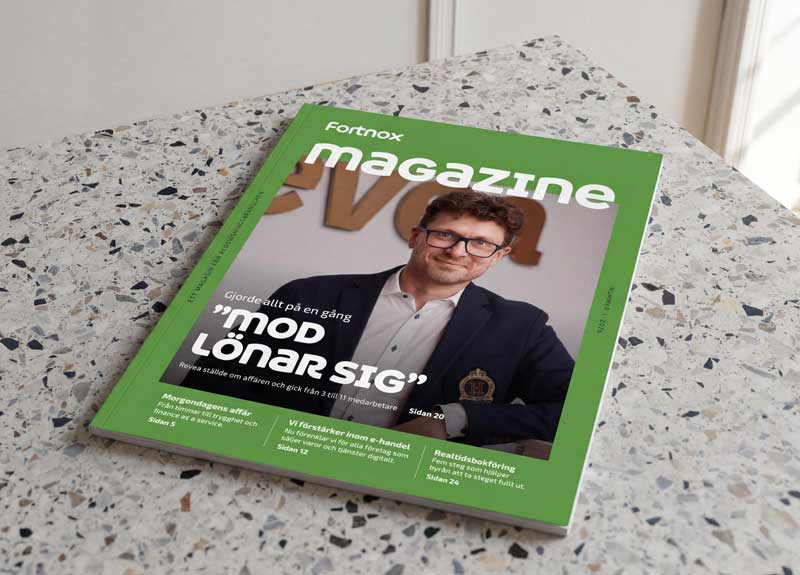
Revea in Fortnox Magazine: "You have to dare"
In the latest issue of Fortnox Magazine, our CEO Martin Krus is interviewed about the decision to dare to change everything at once. A year ago, Revea consisted of three consultants. Today, we are eleven employees sitting in newly renovated premises in central Stockholm, working with companies that have high demands for structure, pace, and technical excellence.
Challenging traditional ways of working
The foundation for the change was a feeling that the traditional offering in the industry was not enough. To stand out and create clearer customer value, Revea chose to scrap continuous hourly billing. Instead, the business is now built on transaction-based pricing and clear packages – something that is particularly suitable for larger companies with complex flows.
— "We decided to do everything at once. New packaging, new premises, new clients, and new competencies. It requires courage and a very clear plan," says Martin Krus in the interview.
Technology that strengthens relationships
A central part of Revea's way of working is the use of modern technology. Automation, system support, and AI support for reporting and interpreting numbers are no longer optional, but a prerequisite for delivering at a high level. However, Martin emphasizes that technology must never replace personal contact.
— "Technology should strengthen us, not replace the relationship," he explains.
Seven authorized consultants
Today, Revea has reached a rolling turnover of around SEK 12 million. Out of the eleven-person strong workforce, seven are authorized accounting consultants, making up about 65% of the team. This is proof that the investment in high competence and a modern way of working has paid off.
Do you want to read the full interview?
You can find the feature on Revea on page 21 in the digital version of Fortnox Magazine: Read the magazine here

Accounting Services for Companies in Sweden – Standards, Reporting and Financial Security (2026)
In 2026, Sweden remains a leader in the digitalisation of business processes within the European Union. For Polish investors, this means that accounting services for companies in Sweden are no longer simply a matter of recording invoices – they are an advanced real-time reporting process. Errors in adapting to Swedish standards (e.g. incorrect K2 vs K3 classification) can result not only in corrections but also in a loss of credibility with business partners and banks.
Legal framework and the role of the Accounting Standards Board
The foundation on which every legitimate company in Sweden rests is the Accounting Act (Bokföringslagen). However, it is the guidelines issued by the Swedish Accounting Standards Board (Bokföringsnämnden – BFN) that determine how a company’s financial transactions must be correctly recorded.
In 2026, the key distinction for entrepreneurs is between simplified rules and full financial reporting. A professional accounting firm in Sweden must precisely determine whether a given entity qualifies as a “smaller company” and may apply K2 rules, or whether it must transition to the more complex K3 standard. This is the best way to maintain a transparent financial position and avoid questions from auditors.
Scope of accounting services for different entity types
The Swedish market demands flexibility. A comprehensive offering from accounting firms extends far beyond large corporations. The accounting requirements for sole traders, small trading companies and foreign branches each have their own nuances – but the requirement for diligence is the same.
The specifics of the service depend on the legal form:
- Small limited companies (Aktiebolag) – require a full annual report (Årsredovisning) filed with the Swedish Companies Registration Office (Bolagsverket).
- Associations – in small economic associations (Ekonomisk förening), transparency towards members and specific audit rules are key.
- Sole traders – although accounting is simplified, the owner is personally liable, which makes a clean separation of personal and business finances essential.
The table below shows the differences in accounting requirements depending on the type of business activity.
Taxes and settlements with the Tax Authority (Skatteverket)
Dealing with the tax authority is part of everyday business life. Correct tax settlements determine financial liquidity. The corporate income tax rate in 2026 is 20.6%. This is a competitive rate compared to many EU countries, but the tax base is defined very rigorously.
VAT and refunds
VAT in Sweden (Moms) is the area where errors are easiest to make, particularly in intra-EU transactions. Professional accounting covers not only the calculation of tax but also the procedures for claiming tax refunds or recovering overpaid VAT – which is critical for the company’s cash flow.
Declarations and deadlines
Depending on turnover, VAT returns are filed monthly, quarterly or annually. On top of this, there is an obligation to submit an annual tax return (Inkomstdeklaration 2 for companies). Any delay in submitting data to the tax authority results in automatic penalties and interest charges on the tax account.
Permanent establishment and financial operations
For foreign companies, the concept of permanent establishment is crucial. An incorrect assessment of whether a company has a permanent establishment in Sweden can lead to tax arrears in relation to income tax, property tax or VAT.
The role of an accountant goes beyond data entry here. It includes advising on how to conduct all financial operations in compliance with local currency and tax law. This covers, among other things, the correct documentation of loans between the company and its shareholder (the so-called förbjudna lån – prohibited loans), which are severely penalised under Swedish law.
Why choose a professional accounting firm?
Handling your own accounting in Sweden is possible, but risky. Changing regulations, the language barrier (despite widespread use of English, official correspondence is in Swedish) and the specifics of the banking system mean that outsourcing is the safest option.
A good accounting firm in Sweden operates proactively – it does not just record documents but analyses financial results, warning of potential liquidity issues or suggesting cost optimisation within the bounds of the law. It is a partner that allows you to focus on growing your business, relieving management of the burden of administrative responsibility.
Summary
If you are looking for a partner to take full responsibility for your company’s finances, we invite you to contact the experts at Revea. We will analyse your situation and implement standards that will give you peace of mind.

Employer Contributions in Sweden – Employment Costs and Rules in 2026
For a Polish entrepreneur entering the Scandinavian market, the tax system of our northern neighbours can come as quite a surprise. It is not even the bureaucracy itself – which is highly digitalised in Sweden – but the real cost of employment. If you are planning expansion or already operating there, the key term you will need to know inside out is employer social security contributions in Sweden (arbetsgivaravgifter).
In 2026, the trend continues whereby the employer bears the main burden of social insurance. Below we break down these costs in detail, explain the differences when posting workers, and advise on when you might pay less.
How much are employer contributions in Sweden in 2026?
In Sweden, there is no split between a contribution deducted from the employee’s salary and one paid by the company in the same way as in Poland. Here, the employee pays income tax (municipal and national), while the company covers full social insurance on top of the gross salary. Standard employer contributions in Sweden amount to 31.42% of gross pay.
What does this mean in practice? If you agree a salary of 40,000 SEK gross with an employee, your actual cost is more than 12,500 SEK higher – which you must pay over to the Swedish Tax Authority (Skatteverket).
What does the charge consist of?
The 31.42% is made up of several different types of insurance. It is worth knowing exactly what you are paying for, particularly in the context of any potential overpayment or corrections. The table below shows the breakdown of social insurance contributions (averaged figures for a standard working-age employee).
Individual components may be subject to minor adjustments depending on the current budget decisions for 2026, but the total typically hovers around 31.42%.
Will you always pay 31.42%? Reliefs and exceptions
The Swedish tax system promotes the employment of certain social groups. As a result, the level of payroll surcharges is not always the same.
In the past, Sweden frequently applied discounts for people entering the labour market (e.g. aged 15–18). In 2026, it is worth checking whether contributions for seasonal workers during the summer period are lower – this is common practice.
Employing a pensioner in Sweden is highly advantageous. In such cases, employer contributions drop sharply and generally cover only the pension insurance component (approx. 10.21%).
If your company carries out innovative (research and development) activities in Sweden, you may be eligible to apply for a reduction in contributions.
Polish company working in Sweden – posted workers or a branch?
This is the most common dilemma: if I send employees out on contract, do I have to pay Swedish employment contributions?
The principle is straightforward, but comes with many exceptions. If a Polish company posts a worker to provide services in Sweden:
Up to 183 days per year – the employee is generally taxed in Poland and you pay ZUS social contributions in Poland (on the basis of form A1).
Over 183 days or “personnel hire” – the situation becomes more complex. Since 2021 (continuing into 2026), Sweden takes a very strict approach to the so-called economic employer concept. Even if the worker is formally employed in Poland but works under the direction of a Swedish entity and for its benefit, a tax liability may arise from the very first day.
If a permanent establishment arises in Sweden, employees are hired on local terms, or long-term contracts are in place, employer contributions become your obligation.
Registering as an employer with Skatteverket
To pay contributions, you must register as an employer with Skatteverket. You can apply for F-skatt (for business owners) or register solely for VAT and employer purposes. From that point on, you are required to submit monthly reports.
Declarations and deadlines – AGI (Arbetsgivardeklaration)
The Swedish system is unforgiving of the tardy but transparent for the organised. The key document is the AGI (Arbetsgivardeklaration) – the individual-level employer declaration.
In the monthly declaration (typically due by the 12th of the month for the previous month) you must report: gross salaries paid, income tax withheld from the employee, employer contributions calculated, and any taxable benefits (company car, accommodation). Everything is done electronically.
If your company does not have a Swedish registration number but posts workers and must withhold tax (SINK or standard), you are also required to submit these reports.
How much can a mistake cost per year?
Penalties for late submission of declarations or late payment are automatic. Interest accrues from the first day of delay. In the event of an incorrect calculation – for example, understating the contribution base – the authority may impose an additional surcharge (skattetillägg), which is typically 20% or 40% of the undeclared amount.
Summary
When planning operations in Sweden and budgeting for 2026, for every net salary you want to offer an employee you must add: Swedish employee income tax (approx. 30%, though this varies by municipality – kommunalskatt), employer contributions (approx. 31.42% of gross), and any additional insurance (FORA), often required under collective agreements (Kollektivavtal).
Accounting in Sweden demands precision. Incorrectly classifying a salary component as non-taxable can result in having to pay back social insurance contributions with interest even years later. If your business is moving into a phase of permanent presence in the Swedish market, a consultation with our accounting firm is an investment that pays for itself in peace of mind and tax security.
Swedish Authorities Every Employer Should Know
Starting a business in Sweden or posting workers there often raises the same questions:
which authorities do you need to register with, who is responsible for what, and what obligations does this create?
The Swedish administrative system is transparent, but employer obligations are spread across several key institutions. A lack of knowledge about their respective roles can lead to delays, formal errors, and ultimately sanctions or costly corrections.
Below is an overview of the most important Swedish authorities that every employer should know — along with a practical explanation of what obligations arise in relation to each.
The Swedish Tax Agency – the hub for taxes and employees
Skatteverket
Skatteverket is one of the most important authorities for companies operating in Sweden. Almost every business activity, salary payment, or employment relationship creates obligations toward this agency.
What Skatteverket handles:
- company registration for tax purposes
- issuing F-tax certificates (F-skatt)
- VAT registration
- reporting salaries and employee data
- receiving tax returns
Why it matters:
For employers, Skatteverket is central to payroll, reporting, and employee taxation. Errors in reporting frequently result in retroactive corrections and additional costs.
The Swedish Companies Registration Office – the formal side of business
Bolagsverket
Bolagsverket is responsible for the formal existence of companies in Sweden and their registered information.
What Bolagsverket handles:
- company registration (e.g. Aktiebolag – AB)
- registration of board members and directors
- receiving annual financial statements
- registering changes to company structure
Why it matters:
Without correct registration at Bolagsverket, a company cannot operate fully — many subsequent obligations (banking, taxes, contracts) depend on it.
The institution managing collective insurance
Fora
Fora administers collective insurance under collective bargaining agreements, in particular for employees covered by the SAF-LO system.
What Fora handles:
- reporting employee salaries
- calculating and administering collective insurance contributions
- updating employee records
Why it matters:
For many employers, obligations toward Fora arise automatically when hiring employees covered by collective agreements. Failure to report can result in surcharges and retroactive corrections.
The Work Environment Authority – posting and workplace safety
Arbetsmiljöverket
Arbetsmiljöverket is responsible for working conditions and workplace safety in Sweden.
What Arbetsmiljöverket handles:
- registration of posted workers in Sweden
- the requirement to have a contact person in Sweden
- supervision of health and safety regulations
- on-site workplace inspections
Why it matters:
For companies posting workers, Arbetsmiljöverket is often one of the first authorities to deal with. Failure to register a posting can result in administrative fines.
The Social Insurance Agency – Sweden's equivalent of a social security office
Försäkringskassan
Försäkringskassan manages Sweden's social insurance system.
What Försäkringskassan handles:
- sickness benefits
- parental and family benefits
- coordination of social insurance systems
Why it matters:
For employers, this authority is primarily relevant in the context of sick leave, absence management, and employee insurance — especially in international employment situations.
The construction sector union – essential for building companies
Byggnads
Companies operating in the construction industry or posting workers to Swedish construction sites need to be aware of the role of Byggnads.
What Byggnads handles:
- representing construction sector workers
- monitoring compliance with collective agreements
- inspecting employment conditions and wages
- on-site interventions at construction projects
What obligations an employer may have:
- applying the conditions set out in collective agreements
- providing payroll and employment documentation
- cooperating during on-site inspections
Why it matters:
Inspections in the Swedish construction sector are frequent, and non-compliance can lead to disputes, project delays, and additional costs.
Why knowing the Swedish authorities genuinely reduces risk
The Swedish administrative system is built on a clear division of responsibilities — but in practice this means:
- obligations are spread across multiple authorities
- a single formal error can have consequences across several agencies
- a lack of awareness leads to delays and corrections
For foreign companies and employers posting workers, understanding the full institutional landscape — not just individual obligations — is key.
Posting Workers to Sweden – Payroll, Working Time Records and Employer Obligations
Posting workers to Sweden means that employees of a foreign employer temporarily perform work on Swedish territory. From an operational perspective, it is crucial to understand that payroll processes must comply with Swedish law throughout the entire posting period.
This applies in particular to:
- payroll calculation and processing,
- working time records,
- reporting and data archiving,
- consistency of documentation for inspection purposes.
Remuneration of Posted Workers in Sweden
One of the employer's fundamental obligations is to ensure that the posted worker's remuneration complies with Swedish regulations.
In practice, this means taking into account:
- working time and rest period standards,
- minimum pay conditions,
- sector-specific allowances and benefits arising from the nature of the work.
Sweden does not have a single statutory minimum wage. In many industries, pay levels and supplements are set by collective agreements (kollektivavtal). For payroll purposes, this means that pay must be correctly reconciled with the employment contract, actual hours worked and the payroll register.
Working Time Records in Sweden – What Employers Must Maintain
Working time records are one of the most frequently inspected areas when posting workers to Sweden.
Under applicable regulations:
- standard working time is 40 hours per week,
- overtime is an exception and subject to limitations,
- working time must be recorded in a transparent and verifiable manner.
The most common practical issues include:
- manual timekeeping records,
- lack of hour-approval procedures,
- discrepancies between time records and payroll.
With a larger workforce, even minor errors in time records can lead to retrospective corrections and increased inspection risk.
Payroll When Posting Workers to Sweden
Processing payroll for workers posted to Sweden is more complex than standard domestic payroll. It requires, among other things:
- calculating pay based on actual hours worked,
- accounting for allowances and changes during the pay period,
- preparing corrections in the event of errors or changes to working conditions.
The greater the number of posted workers, the more important it becomes to have:
- automated processes,
- a single source of data,
- quality control of payroll both before and after salary calculation.
Documentation and Reporting When Posting to Sweden
An employer posting workers to Sweden should maintain complete and well-organised documentation covering, among other things:
- payroll registers,
- working time records,
- terms and conditions of employment,
- posting periods.
This documentation must be:
- consistent,
- up to date,
- available in the event of an inspection.
Incomplete documentation or inconsistent data are among the most common causes of problems when posting workers to Sweden.
Common Mistakes When Posting a Large Number of Workers
Companies posting workers to Sweden most commonly struggle with:
- lack of a consistent payroll system,
- manual processes that do not scale with the number of workers,
- frequent retrospective corrections,
- data discrepancies between different countries.
These issues grow in proportion to the scale of posting and generate additional operational costs.
Why Organised Payroll is Critical
For companies posting a large number of workers to Sweden, payroll ceases to be purely an administrative function. It becomes an element of:
- risk management,
- regulatory compliance,
- cost control,
- operational stability.
Accurate working time records, correct payroll processing and complete documentation are the foundation of safe, long-term worker posting to Sweden.
Summary
Posting workers to Sweden requires far more from an employer than one-off formalities at the start of a project. In practice, correct payroll processing, accurate working time records and consistent documentation are what determine whether operations run smoothly.
A lack of organised HR and payroll processes quickly leads to corrections, increased inspection risk and difficulties in managing costs. On the other hand, a well-structured payroll system – based on a single data source and automated processes – significantly reduces operational risk and provides a solid foundation for cross-border business.
For companies operating internationally, posting workers to Sweden should be treated as an ongoing operational process that requires continuous monitoring and regular updating – not a one-off administrative task.
Do you need support with payroll or documentation for posted workers? Contact us at Revea – we help companies navigate Swedish regulations and set up compliant payroll processes.

Inheritance and Gift Tax in Sweden – What Actually Applies?
Sweden is often perceived as a high-tax country. This makes it all the more surprising for many people – especially foreigners – to discover that there is no inheritance or gift tax here. This is a solution that has been in place for years and represents a significant difference compared to many other European countries.
However, the absence of such a tax does not mean that inheritance and wealth transfer issues are completely tax-neutral. In practice, what matters is not only the moment of receiving assets, but also what happens with them later – and in what legal and international context we find ourselves.
Why doesn't Sweden have inheritance and gift tax?
Inheritance and gift tax was abolished in Sweden in 2005. It was deemed costly to administer while simultaneously leading to undesirable consequences – including hindering family business succession and estate planning.
Since that moment, the mere fact of receiving an inheritance or gift does not create a tax obligation, regardless of the asset value or degree of kinship.
What does this mean in practice for someone receiving assets?
A person who receives an inheritance or gift in Sweden:
- does not pay tax on their value,
- does not report them as income in their tax return,
- does not file a separate tax return solely for this reason.
However, this does not mean there are no formalities. In the case of inheritances, civil law procedures still apply, such as preparing a bouppteckning (estate inventory) or registering ownership changes, e.g., real estate or shares.
When can tax consequences arise?
Although receiving assets itself is tax-free, taxation may appear at a later stage. This most commonly concerns situations when inherited or received assets are sold.
In such cases, capital gains tax arises, calculated on the difference between the sale price and the so-called historical value. Importantly, in the case of inheritances and gifts, the acquirer "inherits" the tax history of the asset – and thus also its original acquisition price.
In practice, this may mean higher tax upon sale, even if the acquisition itself was untaxed.
Gifts and business activities
Particular caution is required for gifts made in relationships connected with business activities. Transferring assets between a company and its owner or a related person is not always treated as a gift in the tax sense.
Depending on circumstances, it may be considered, for example, as remuneration, dividend or other taxable income. In such situations, the absence of gift tax in Sweden does not apply.
Inheritances and gifts in an international context
For persons living in Sweden but possessing assets abroad – or vice versa – the international context is crucial.
Although Sweden does not levy inheritance and gift tax, other countries may impose it, for example due to the location of assets, the tax residence of the deceased or citizenship.
Therefore, in cross-border situations, it's always worth checking whether tax obligations don't arise outside Sweden.
Significance of gifts and inheritances in family law
It's also worth remembering that inheritances and gifts – despite the absence of taxation – have significance from the perspective of family law. They may affect, among others:
- division of property upon divorce,
- settlements between heirs,
- the right to a reserved portion (laglott).
For this reason, their form and documentation are often as important as tax aspects.
Common misconceptions
In practice, there is often a belief that since Sweden has no inheritance and gift tax, these matters are completely "invisible" to the tax system. Meanwhile, Skatteverket is interested in tax consequences that may appear later, not the mere fact of receiving assets.
Summary
Sweden offers very favorable solutions regarding inheritances and gifts. The absence of tax on their receipt provides great freedom in estate planning. At the same time, it's worth remembering that taxation may appear at a later stage or in an international context.
A conscious approach and prior analysis allow avoiding misunderstandings and unexpected costs.
Revea – support in tax and international matters
At Revea, we help clients understand the tax implications of inheritances and gifts in Sweden and in international relations – clearly, calmly and without unnecessary complications.
If you would like to discuss your situation, we invite you to contact us.

What tax obligations do foreign companies operating in Sweden have in 2026?
Sweden has for many years remained an attractive market for foreign entrepreneurs – both in the service sector, as well as project-based, technological and construction industries. An increasing number of companies are executing contracts here, seconding employees or collaborating with Swedish clients on a permanent basis.
In 2026, the taxation rules for foreign companies in Sweden remain largely stable, however the practice of their application is becoming increasingly systematized. The Swedish Tax Agency (Skatteverket) places great emphasis on ensuring that business activities conducted on Swedish territory are correctly classified for tax purposes – especially regarding the place of work performance, employer status and reporting obligations.
For foreign companies, this means the necessity of a conscious and thoughtful approach to their tax obligations, even before starting operations or executing a project in Sweden.
In this article, we explain what tax obligations may apply to foreign companies operating in Sweden in 2026 and what is worth paying attention to in practice.
When can a foreign company be subject to taxation in Sweden?
A foreign company is not always automatically subject to taxation in Sweden. The tax obligation arises only when certain conditions are met, particularly when the company:
- performs work physically on Swedish territory,
- employs workers who perform work in Sweden (also temporarily),
- executes projects or services requiring presence in Sweden,
- has or may be considered to have a permanent establishment (fast driftställe),
- meets the conditions of so-called limited tax liability.
In practice, the decisive factor is the place where work is actually performed, not solely the company's registered office or the country where invoices are issued.
Registration of a foreign company in Sweden
Depending on the nature of operations, a foreign company may be required to register with Skatteverket as:
Employer (arbetsgivare) – if it pays salaries for work performed in Sweden.
F-tax taxpayer – if the activity is of a permanent nature or the company independently handles tax settlements.
F-tax is also significant for relations with Swedish clients.
VAT taxpayer (momsregistrerad) – in case of services or supply of goods subject to VAT taxation in Sweden.
It's worth emphasizing that registration itself does not always mean an obligation to pay income tax, but almost always involves reporting obligations.
Obligations of a foreign employer
If a foreign company employs workers performing work in Sweden, an obligation may arise to:
- register as an employer,
- withhold preliminary tax (preliminärskatt),
- report salaries to Skatteverket.
In standard cases, when an employee does not have an individual tax decision, a preliminary tax rate of 30% is applied.
However, some situations may be subject to exceptions, for example based on:
- double taxation agreements,
- special arrangements (e.g., Öresund agreement),
- work performed entirely outside Sweden.
Each case requires individual analysis.
Obligation to submit "special information"
Foreign companies that do not have a permanent establishment in Sweden but conduct activities related to the Swedish market may be required to submit annual "special information" (särskilda uppgifter).
The purpose of this obligation is to enable Skatteverket to assess whether:
- there is an obligation to file a tax return,
- the company should be registered as an employer,
- a tax obligation arises in Sweden.
The deadline for submitting information is the same as the deadline for tax returns.
Permanent establishment (fast driftställe)
If a foreign company's activity in Sweden is of a permanent nature and involves physical presence – for example, through an office, technical facilities, long-term project or local personnel – a permanent establishment may arise.
In such a case, the company is treated as an entity conducting business in Sweden and is subject to Swedish taxation and accounting rules.
VAT in the operations of foreign companies
Foreign companies may be required to register for VAT in Sweden, among others, when:
- they provide VAT-taxable services in Sweden,
- they sell goods on Swedish territory,
- they have a warehouse or inventory in Sweden,
- they provide services to private individuals.
The applicable VAT rates are 25%, 12% and 6%, depending on the type of activity.
Cooperation with Swedish clients
If a foreign company performs work physically in Sweden and does not have F-tax, the Swedish client may be required to withhold 30% preliminary tax from the remuneration.
Therefore, in practice, F-tax is often a condition for starting cooperation.
Work performed outside Sweden
If all work is performed outside Swedish territory, and the company has no personnel or infrastructure here, as a general rule, no Swedish tax obligation arises, even if the client is Swedish.
Summary
For foreign companies operating in Sweden in 2026, the key factors are:
- correct assessment of the place where work is performed,
- proper registration with Skatteverket,
- distinction between tax obligations and reporting-only obligations,
- conscious management of the relationship with Swedish clients.
Revea – support for foreign companies in Sweden
At Revea, we help foreign entrepreneurs safely and transparently conduct business in Sweden – from initial analysis, through registrations, to ongoing settlements and contact with Skatteverket.
If you want to be sure that your business in Sweden is properly structured from a tax perspective, we invite you to contact us.

Tax reporting for the IT and tech sector in Sweden — key trends and legal changes for 2026
The IT sector is one of the pillars of the Swedish economy. Technology companies, startups and development teams have long attracted global capital, and demand for highly qualified specialists continues to rise. As the industry evolves, the tax landscape changes with it — especially in areas connected to international work, remote setups and cross-border operations.
In 2026, several trends and regulatory developments are particularly important for IT businesses operating in Sweden or delivering projects for Swedish clients.
Remote work and distributed teams — new tax standards
Tech companies increasingly hire specialists working from different countries — including Poland. In practice, this means you must be able to:
- determine where social security contributions should be paid,
- clarify the employer’s obligations in Sweden and abroad,
- handle cost treatment and reimbursement linked to remote work,
- report employment correctly and on time.
In 2026, the Swedish Tax Agency (Skatteverket) continues to emphasize that the key factor is the place where the work is actually performed, unless rules on postings (secondments) or EU exceptions apply.
Obligations for foreign IT companies providing services in Sweden
Companies outside Sweden — including Polish software houses — may be required to:
- register as an employer in Sweden,
- pay Swedish social security contributions for employees working in Sweden,
- handle wage tax-related reporting,
- report to Skatteverket within the PAYE framework where applicable.
For software houses delivering projects on-site or in a hybrid model, these obligations are especially relevant.
Tech startups and ownership structures — what still applies
Many Swedish tech companies use holding structures that can:
- support scaling and new investments,
- enable more efficient capital gains taxation,
- improve long-term planning of profit distributions,
- protect intellectual property.
Sweden’s tax system continues to be favourable for holding companies in several contexts — including, for example, how share disposals may be treated.
Taxation of IT specialists — key risk areas
Salaries in the tech sector are often above market averages, making correct classification and reporting crucial. Typical focus areas include:
- correct calculation of social security contributions,
- cross-border employment and payroll handling,
- EU rules for posting/secondment where relevant,
- proper classification of B2B contractor vs. employment.
Misclassification can lead to tax arrears and liabilities — affecting both the worker and the employer.
R&D relief as a cost factor (but not the main topic)
Many tech businesses make use of Sweden’s R&D relief (Forskningsavdrag). In this article, however, it is only one part of the broader tax ecosystem, not the main focus.
For some IT companies it can be relevant — but not all technology activity automatically qualifies as R&D.
Tax trends in IT for 2026
Key observations for the year ahead:
- greater importance of cross-border work setups,
- more software houses supporting Swedish clients from abroad,
- more frequent reviews of “where the work is performed” and where it should be taxed,
- increased relevance of PAYE reporting for foreign employers,
- clearer approaches to remote work after the pandemic years,
- stronger focus on compliance in tech and digital services.
Summary
Sweden’s IT sector is growing fast, and its working models make tax matters more complex than in many traditional industries. Remote work, international teams, hybrid delivery and the increasing number of foreign providers mean that tax preparedness is essential.
Tech companies should continuously monitor obligations connected to employee taxation, payroll reporting, social security contributions and cross-border activity — and make sure documentation and classifications are correct.
Revea supports IT companies across Sweden
We can help you:
- clarify tax obligations for IT employees,
- manage teams working from different countries,
- assess when a company must register as an employer in Sweden,
- handle full accounting and advisory services for tech companies,
- support Polish software houses delivering services to Swedish clients.
Contact us — we’ll be happy to review your specific setup.
08-678 18 40 or info@revea.se
New Laws and Regulations 2026: The Complete Guide for Swedish Business Owners
When the fog of New Year's celebrations has settled, it's time for Sweden's business owners to look forward. 2026 is a year characterized by both simplifications and new administrative requirements in the Swedish tax system. For many owners of closely held companies, the year's big news is the new dividend rules, but changes are also happening in sustainability and HR that require attention.
We have compiled the most important legislative changes and updates that have come into force or are waiting just around the corner.
The New 3:12 Rules – Simpler and Often More Favorable
Perhaps the most anticipated change for owners of Swedish small businesses is the new 3:12 rules that came into effect on January 1, 2026. The purpose of the reform has been to simplify the complex regulatory framework and equalize differences between different types of shareholders in the Swedish tax system.
Here are the most important changes:
- Simpler calculation: The previous simplification rule (standard amount) has been replaced with a new basic amount based on the income base amount. This makes the Swedish system more predictable.
- Eliminated salary withdrawal requirement: The controversial salary withdrawal requirement (that you must withdraw a certain salary to be credited with a salary basis) has essentially been removed and replaced with a standard deduction. This particularly benefits shareholders in companies with many employees but where the owner themselves does not withdraw a market-level top salary.
- Shorter waiting period: The time limit for "waiting period companies" (shell companies) has been shortened from five to four years, making it smoother for liquidation or restructuring under Swedish tax law.
For those planning this year's dividend distribution, this means you should review your calculations together with your Swedish accounting consultant, as the room for low-taxed dividends may have increased.
Corporate Tax Remains Unchanged
Although proposals were discussed and submitted in 2025 to reduce the Swedish corporate tax from 20.6% to 20% as a growth measure, the reduction was not implemented in the final budget for 2026. The corporate tax in Sweden thus remains at 20.6% for the time being. However, other reliefs have been introduced, including reduced tax on employment income (see below).
CSRD: More Companies Now Covered by Sustainability Requirements
The EU directive for sustainability reporting, CSRD (Corporate Sustainability Reporting Directive), continues to be rolled out. From the financial year beginning in 2025 (with reporting in 2026), large Swedish companies that meet at least two of the following three criteria are now also covered:
- More than 250 employees
- More than SEK 550 million in net turnover
- More than SEK 280 million in balance sheet total
This means that significantly more Swedish unlisted companies must now report their climate impact, social responsibility, and governance according to the ESRS standard. For smaller companies not yet directly covered, it is still high time to start collecting data, as larger customers and banks will increasingly demand this information as part of their own supply chains.
Labor Market: Prepare for Pay Transparency
One of the most important changes to prepare for during the spring is the Pay Transparency Directive. Although full implementation in Swedish law occurs in summer 2026, employers should act now.
The directive requires Swedish employers to be able to report pay gaps between genders and give employees insight into pay setting.
- What does it mean? Job seekers have the right to receive information about starting salary or salary range already in the recruitment process. Employees gain the right to request information about average salary levels for equal or equivalent work.
- Tip: Review your salary mappings and ensure you have clear, gender-neutral criteria for salary setting before the law fully comes into force.
Economy and Tax: This Applies in Sweden for Tax Year 2026
Enhanced Earned Income Tax Credit and Reduced Tax on Pensions
The Swedish government has implemented a further enhancement of the earned income tax credit. This means more money in the wallet for most wage earners in Sweden, with an average tax reduction of a few hundred kronor per month. Tax on pensions has also been reduced to increase incentives for a longer working life and strengthen the economy for elderly people.
Increased Travel Deduction
Positive news for commuters is that the travel deduction threshold is being adjusted in the Swedish tax system. For tax year 2026, the lower amount threshold for when you can start deducting travel to and from work has been raised from 11,000 kronor to 15,000 kronor. This means that only costs exceeding 15,000 kronor are deductible, which is a tightening compared to previous years.
ROT and RUT
The temporary increase in the ROT deduction ceiling that applied during the second half of 2024 is gone. From 2025 onwards, the regular levels apply in the Swedish tax system:
- ROT: Maximum 50,000 SEK per person per year (30% of labor cost).
- RUT: Maximum 75,000 SEK per person per year (50% of labor cost).The combined ceiling for ROT and RUT is 75,000 SEK per person per year.
Reduced Tax on Fuel
In line with the Swedish government's energy policy, the tax on gasoline and diesel was reduced at the turn of 2025/2026. Together with adjustments in the reduction obligation, this aims to keep transport costs down for both private individuals and businesses in Sweden.
Important Reminders from Previous Year
Some rules introduced in 2025 have now taken full effect or are important to be reminded of:
- Växa Support: The rules for reduced employer contributions for the first employees (Växastödet) now cover the first two employees, making it cheaper for Swedish sole proprietors to start hiring.
- Late Filing Fees: The Swedish Companies Registration Office (Bolagsverket) has increased fees for late submission of annual reports. It is now more expensive than ever to neglect deadlines – the first fee is 7,500 SEK.
- Digital Submission: More and more Swedish business forms are encouraged (and will eventually be required) to submit annual reports digitally. If you haven't switched yet, 2026 is the year to do it.
Footnote: The information in this article is based on applicable Swedish legislation and budget decisions as of January 2026. We always recommend that you verify specific tax matters with a qualified Swedish advisor.