Insights & news from Revea
Here you will find news and insights about us, the industry and the wider economy.


Tax Harmonization in the EU: Challenges and Benefits for Companies Operating in Sweden
What Is Tax Harmonization?
Tax harmonization involves the gradual alignment of tax rules across EU member states. It does not mean complete unification of national legislation but rather the elimination of differences that hinder the integration of national markets.
The goal is to ease cross-border business, reduce fiscal barriers, and establish consistent competitive conditions. However, this process also raises concerns about the loss of tax sovereignty among member states.
Challenges Related to Harmonization
Every change in the tax system affects a country’s economic conditions. Harmonization may disrupt existing mechanisms, such as incentive schemes or local tax reliefs.
For years, experts have debated whether the benefits of harmonization outweigh its costs and risks. Tax systems across member states differ significantly in structure and budget impact.
Moreover, harmonization may weaken the position of countries with attractive tax regimes, such as those with low corporate income tax rates (CIT).
Sweden’s Tax System and EU Integration
In Sweden, taxes are relatively high and serve a redistributive function. The Swedish Tax Agency (Skatteverket) enjoys a high level of public trust. Income tax for individuals ranges from 30% to 55%, while corporate tax is 28%. VAT and payroll taxes are added on top.
Foreign companies operating in Sweden are subject to limited tax liability – they only pay taxes on income generated within Sweden. The scope of taxation can also be restricted by international tax treaties.
For Sweden, harmonization may require the country to align its national regulations with EU standards – which could present both opportunities and risks.
Is Harmonization Beneficial for Sweden?
Compared to other EU countries, Sweden ranks in the middle when it comes to corporate tax rates. Countries like Malta or Denmark have higher rates but follow different tax models.
In Western Europe – including Sweden – taxes are primarily seen as a tool for redistribution. In Central and Eastern Europe, the emphasis is often on attracting foreign investment through tax incentives.
These differences suggest that full tax harmonization may not be in the best interest of countries like Sweden, which have highly developed welfare systems and complex tax structures.
The New BEFIT Directive – Toward a Common Tax Base
In September 2023, the European Commission proposed the BEFIT directive (Business in Europe: Framework for Income Taxation), aimed at creating a unified method for calculating the corporate tax base across the EU.
Key objectives of BEFIT include:
- A single method for calculating the tax base across EU countries
- Cross-border profit and loss offsetting within corporate groups
- Simplified tax supervision and compliance
- Elimination of withholding tax on intra-group transactions
BEFIT is a continuation of previous efforts to integrate taxation within the internal market. For Sweden, it means adapting its CIT reporting rules, particularly for large multinational enterprises operating in the EU.
Who Will BEFIT Apply To?
The new regulations will apply to capital groups (domestic and international) that:
- Prepare consolidated financial statements
- Exceed €750 million in annual revenues in at least two of the last four fiscal years
Exemptions apply to groups whose parent company is based outside the EU or whose EU-generated revenues are below €50 million or account for less than 5% of the group’s global revenue.
The sector of activity is not a determining factor for inclusion, though some industries – such as aviation or mining – may be subject to special rules.
How Will CIT Be Calculated Under BEFIT?
The calculation process will consist of several steps:
- Each group entity calculates its tax base according to BEFIT rules
- All tax bases are combined into one unified base
- The common base is allocated to group entities using a fixed formula
- Each entity is taxed at the local CIT rate applicable in its country
Sweden’s Position on BEFIT
Sweden supports the idea of a common tax base functioning in parallel with the national CIT system. The country also insists on maintaining control over the entry and exit conditions for companies in the system.
This cautious stance reflects Sweden’s intent to protect its domestic tax model and carefully assess the directive’s impact on small and medium-sized enterprises (SMEs).
Conclusion
EU tax harmonization is a long-term process aimed at reducing administrative barriers and facilitating cross-border business. For companies operating in Sweden – especially large corporate groups – the new rules may simplify reporting but also require adaptation to common standards.
Do you need help with corporate tax planning or understanding BEFIT’s impact on your group? Contact Revea – we’ll help you navigate the changes and prepare for the future of taxation in the EU.

VAT on Services in the EU and Providing Services in Sweden – Latest Guidelines
VAT in Sweden – Basic Information
In Sweden, VAT is known as Mervärdesskatt. The standard VAT rate is 25%, with reduced rates of 12%, 6%, and 0%.
- 12% applies to restaurant services, non-alcoholic beverages, antiques, etc.
- 6% covers books, tickets to sports and cultural events, etc.
- 0% applies to some medicines and passenger transport services.
When is VAT Registration in Sweden Mandatory?
A foreign company must register for VAT in Sweden if it:
- Sells goods or services within Sweden
- Imports or exports goods
- Stores goods in Sweden for distribution within the EU
- Conducts e-commerce exceeding €10,000 in annual turnover
Once the threshold of €10,000 is surpassed, the company must either register for VAT in Sweden or use the One Stop Shop (OSS) scheme. If the turnover remains below this level, VAT can be reported in the country of establishment.
How to Register for VAT in Sweden
To obtain a Swedish VAT number, an application must be submitted to the Swedish Tax Agency along with:
- A copy of a passport (for sole traders)
- A certificate of business registration
VAT Obligations for Foreign Companies in Sweden
Once registered, a company is required to charge VAT at the appropriate rate and submit VAT returns. VAT returns can be submitted on a:
Monthly Basis
Required for companies with annual turnover above SEK 40 million. Submission deadline: the 26th of the month following the reporting period.
Quarterly Basis
For companies with turnover under SEK 40 million. Deadline: the 12th of the second month after the quarter ends.
Annual Basis
For companies with turnover under SEK 1 million. Deadline: the 26th of the second month after the end of the fiscal year.
VAT in Digital Services and E-Commerce
Since 2021, companies selling goods or services within the EU no longer need to register for VAT in every country where they have customers. VAT can be reported in the country of establishment or via the OSS scheme. Online platforms are responsible for reporting transactions.
VAT Refunds for Non-Registered Foreign Companies
Companies not registered for VAT in Sweden may still apply for a VAT refund. The application must be submitted by the end of June of the year following the tax year. The following documents must be included:
- Invoices (paper or electronic)
- A breakdown of goods and services
- A certificate of taxable status
- Other documents supporting the right to a refund
All amounts must be stated in Swedish kronor (SEK).
When Is VAT Refund Not Granted?
VAT refunds are not available in cases involving:
- Purchase of vehicles (cars, motorcycles)
- Private expenses
- Goods or services unrelated to business activities
- Goods resold to private individuals in Sweden
- Certain representation expenses (partial refund possible)
- Short-term vehicle rentals (up to 50% refund)
Summary
Sweden applies clear rules for foreign businesses regarding VAT. Understanding the applicable rates, registration thresholds, and declaration procedures is essential. If you’re operating across borders, consulting a VAT expert can help you avoid errors and make use of refund opportunities.
Need help with VAT registration or reclaiming VAT in Sweden?
Contact Revea – we provide tax consulting, VAT registration, and full accounting support for international companies.

Simplified Tax Exemption Rules for Temporary Work and Assignments
Daily allowances (per diem) are reimbursements you pay as an employer to cover the increased cost of living for employees during business travel. They typically compensate for food, lodging, and incidental expenses.
Temporary Employment or Assignments at a Different Location for Max One Month
As of January 1, 2022, simplified tax exemption rules apply to temporary work and secondments. If someone takes a temporary position or assignment in a different location for a maximum of one month, they may deduct additional living expenses in the same way as during a business trip.
The workplace must be at least 50 km from the employee’s home, and the assignment must be intended to last no more than one month. If the duration is undefined or intended to be longer, the rules do not apply.
If the conditions are met, you as an employer may pay per diem and travel reimbursements tax-free, as with business travel. You do not need to deduct tax or pay employer contributions on these reimbursements.
What Is a Cost Reimbursement?
A cost reimbursement is a compensation in addition to wages that covers specific work-related expenses incurred by the employee.
Such allowances may be tax-exempt if paid under certain conditions. Per diem and mileage reimbursements up to standard rates are examples of tax-free benefits.
If you pay reimbursements exceeding standard limits, the excess must be treated as taxable income—meaning you must deduct tax and pay social contributions on that portion.
Conditions for Tax-Exempt Reimbursements
To qualify for tax exemption, the following three conditions must be met:
- The employee undertakes a business trip with overnight stay more than 50 km away from their usual place of work and residence
- The amount paid does not exceed the standard daily allowance rates for domestic or international travel
- You as employer have documentation, e.g., a travel expense report, detailing the business trip
- Your right to pay reimbursements tax-free is linked to the employee’s right to make deductions
👉 Swedish Tax Agency: Reimbursements and Silent Offsetting (in Swedish)
👉 Swedish Tax Agency: What Is Business Travel? (in Swedish)
Mileage Reimbursement
If employees use their private car for business travel, you may pay them a tax-free mileage allowance of 18.50 SEK per Swedish mile (10 km).
If the employee drives a company car and pays for all the fuel themselves, the tax-free reimbursement is:
- 6.50 SEK/mile for diesel
- 9.50 SEK/mile for other fuels like gasoline, electricity, or ethanol
If public transport is used, you can reimburse the actual cost.
👉 More info on travel expense reimbursements (in Swedish)
What Are the Standard Tax-Free Allowance Rates?
The standard amounts vary depending on the travel duration and whether the trip is domestic or abroad.
Definitions:
- Full day – Departure before 12:00 and return after 19:00
- Half day – Departure after 12:00 or return before 19:00
- Night schedule – Travel between 00:00 and 06:00
Domestic Travel
International Travel
👉 Full list by country (in Swedish)
Reduced Allowance If Employer Pays for Meals
If you pay for your employee’s meals during a business trip, the allowance must be reduced since the employee did not incur additional food costs. This also affects the tax deduction.
👉 When Should the Allowance Be Reduced and Taxed? (in Swedish)
Summary of Rules for Meal Benefits During Business Travel
👉 More details on reductions (in Swedish)
Allowance Reduction – Domestic Travel
* The 30% deduction applies to people who did not receive an allowance but are claiming deductions for business travel exceeding three months or for double housing.
Allowance Reduction – International Travel

Sweden’s Employment Protection Act (LAS) – What the Current Rules Mean
Understanding Sweden’s Employment Protection Act (LAS)
The Swedish Employment Protection Act (LAS – Lagen om anställningsskydd) lays out the core rules that govern employment relationships in Sweden. It covers how employment begins and ends, and what rights and obligations apply during termination or dismissal.
A major revision to LAS came into force in 2022, introducing important changes that now apply to all employers and employees. Below is a summary of the most relevant rules in effect today.
1. Dismissals must be based on “factual reasons”
Employers must base terminations on clear and objective facts. Unlike the older standard of “objective grounds,” today’s legal requirement is a factual reason. This change limits the influence of personal assumptions or speculation about future behavior when justifying a dismissal.
2. New rules for redundancy order
The “last in, first out” rule still applies when layoffs occur. Previously, only companies with 10 or fewer employees could exempt two people from the redundancy order. Now, all employers, regardless of size, may exempt up to three employees – but only once every three months, and across the entire organization.
3. Full-time employment is the new default
Employment in Sweden is presumed to be permanent and full-time unless otherwise agreed in writing. This means that if no specific agreement is in place, an employee is considered hired on a full-time, permanent basis.
4. New obligations for employers using agency staff
If an agency worker has been placed at the same workplace for 24 months over a 3-year period, the host company must offer permanent employment or pay compensation equivalent to two months’ salary.
5. New model for fixed-term employment
The previous “general fixed-term employment” contract has been replaced with a “special fixed-term employment” model. These contracts automatically convert to permanent employment after 12 months within a five-year period, even across multiple contracts. (Previously, this threshold was 24 months.)
6. Higher compensation for wrongful terminations
Courts still decide damages, but standard compensation amounts have increased:
- Unlawful termination: typically approx. 135,000 SEK (up from 80,000 SEK)
- Unlawful dismissal: approx. 190,000 SEK (up from 125,000 SEK)
7. Relocation investigations simplified
If a dismissal is based on personal misconduct, the employer only needs to investigate the possibility of reassignment once. Even if the employee later repeats similar behavior, no second relocation review is required unless a long period of time has passed since the first.
8. Seniority rules apply to reduction of hours
When reducing working hours across multiple employees, the employer must follow redundancy order principles. Employees with shorter length of service must be offered changes first, before those with longer tenure.
9. New rules for dismissal disputes
If a dismissal is contested, the employment still ends at the end of the notice period. During the legal process, the employer is not obligated to pay salary. The employee can instead claim unemployment benefits. If the court later overturns the dismissal, back pay and increased damages will apply.
Summary
Sweden’s current employment law strengthens clarity for both employers and employees. With full-time, permanent employment as the standard, stricter rules on dismissals, and new frameworks for fixed-term work and agency staffing, the LAS law now provides a more predictable and balanced foundation for the Swedish labor market.

The Tax System in Sweden – Who Pays, How Much, and for What?
Sweden is known for having one of the highest tax burdens in Europe. In return, residents benefit from a strong welfare state, high-quality healthcare and education, and a stable social safety net. Here’s what you need to know about Sweden’s tax system, residency rules, and potential deductions or refunds.
Who Is Subject to Tax in Sweden?
Everyone who works or runs a business in Sweden is subject to taxation – regardless of citizenship. This includes:
- Employees with Swedish income,
- Entrepreneurs operating in Sweden,
- Individuals staying in Sweden for more than 183 days in a 12-month period (become tax residents).
Late filing or failure to report taxes to the Swedish Tax Agency (Skatteverket) can result in penalties, interest charges, or administrative fines.
Current Tax Rates in Sweden (2025)
Swedish Tax Residency
You become a tax resident if:
- You stay in Sweden for more than six consecutive months,
- Your economic and personal interests (e.g., job, home, family) are centered in Sweden.
Tax residents are taxed on their worldwide income. Temporary trips (e.g., short visits to your home country) do not reset the residency period.
Taxable Income Sources in Sweden
You are taxed on the following types of income:
- Employment income,
- Pensions and social benefits,
- Insurance payments,
- Maritime employment income.
Non-taxable items include reimbursement for travel and accommodation.
Self-Employment and Non-Resident Income Tax (SINK)
If you run a business in Sweden but live abroad, you must apply for taxation via form SKV 4350 at the Swedish Tax Agency. For non-residents staying in Sweden less than 183 days per year, a flat SINK tax of 25% applies to gross salary. No annual tax return is required for SINK.
Reporting Swedish Income in Poland
Thanks to the double taxation treaty between Sweden and Poland, Swedish income is not taxed again in Poland. However, it may influence your tax bracket in Poland under the progressive exemption method.
If your business generates income in both countries, Swedish earnings are added to Polish income for rate calculation but not double-taxed.
Tax Refunds and Deductions
If you’ve worked legally in Sweden, you may be eligible for a tax refund – especially if:
- You paid regular taxes and social contributions,
- You can document work-related expenses (e.g., travel, housing, tools).
Examples of deductible expenses:
- Travel to/from work (by car, bus, or train),
- Commuting over 20 km (public transport) or 50 km (car),
- Double household costs (living in Sweden but visiting family abroad),
- Per diem allowances (traktamente),
- Pension contributions,
- Job-related purchases (books, tools, software),
- The Job Tax Deduction (jobbskattereduktion),
- General basic deduction (grundavdraget).
To qualify, at least 90% of your total annual income must be earned in Sweden.
Summary
Sweden’s tax system may be demanding, but it funds one of the world’s most respected public service models. The Swedish Tax Agency enjoys high public trust, and the system offers clarity and predictability – especially for those who understand the rules.

Income Tax Obligations for Foreign Businesses in Sweden
Income Tax Liability
A foreign entity can operate in Sweden either as a sole proprietorship (natural person) or as a corporate entity (legal person). Foreign legal entities have limited tax liability in Sweden. This means they are taxed only on income derived from permanent establishments in Sweden. A permanent establishment refers to a fixed place of business through which the company operates wholly or in part.
Foreign individuals usually also have limited tax liability. However, once they settle or stay permanently in Sweden, they become fully tax liable, meaning they are taxed on all income, both from Swedish and foreign sources.
Entrepreneurs who do not reside or stay permanently in Sweden are taxed only on income generated from business activities carried out through a Swedish permanent establishment.
In some cases, tax liability may be removed or reduced under international tax treaties.
Population Registration (Folkbokföring)
The Swedish population register is a central system for recording residents in Sweden. It contains information on who lives in Sweden and where. Correct registration is crucial, as it affects many rights and obligations – including where a person is taxed.
The register also records civil status and other personal details. Normally, a person should be registered at their place of actual residence, defined as the location where they live on a daily basis.
Registration
A foreign company conducting business in Sweden – regardless of whether it is a legal or natural person – may become liable for:
- VAT,
- social security contributions,
- and income tax.
In such cases, the company must contact the Swedish Tax Agency (Skatteverket) to register and obtain an F-tax certificate.
Instructions for completing the SKV 4632 form (in Swedish) are available on the Skatteverket website under “How to apply for business registration.”
Sole proprietors with a Swedish personal identity number (personnummer), as well as companies with an authorized representative who holds a personnummer, can apply for registration online at Verksamt.se – a joint platform managed by Skatteverket, Bolagsverket, and Tillväxtverket.
Other foreign companies must submit their application directly to the International Office of the Swedish Tax Agency.
As part of the registration process, Skatteverket assigns a unique Swedish identification number to the foreign entrepreneur:
- For individuals, proof of identity (e.g., passport or ID card) is required.
- For legal entities, a certificate of incorporation is needed, and the representative must show authorization to act on behalf of the company (i.e., power of attorney).
Before registering, foreign legal entities should contact Bolagsverket to check whether branch registration is required. If so, Bolagsverket will assign the identification number. Contact details are available on Bolagsverket’s website.
Preliminary Tax Return (PD)
Anyone with income subject to taxation in Sweden is required to pay preliminary tax during the income year. To calculate the amount, the business must submit a preliminary income tax return to the Swedish Tax Agency (Skatteverket).
Based on this return, Skatteverket estimates the amount of tax due and notifies the business of the monthly tax instalments.
In the year following the income year, the business must file a final income tax return, reporting its actual financial results. Skatteverket will then calculate the final tax amount and compare it to the preliminary payments:
- If the company overpaid, it will receive a refund.
- If it underpaid, it must pay the difference.
Foreign legal entities equivalent to Swedish limited companies pay income tax at a rate of 26.3% on taxable profits.
Sole proprietors (natural persons) usually pay both income tax and social security contributions (egenavgifter). Their monthly instalments include both components.
EU law and bilateral social security agreements may in some cases override or adjust the application of Swedish national rules.
Foreign partners in Swedish partnerships (handelsbolag or kommanditbolag) are liable to pay tax in Sweden only if the partnership has a permanent establishment in Sweden. In such cases, the partner must also submit a preliminary tax return to determine monthly tax instalments.
A foreign entrepreneur applying for an F-tax certificate must file a preliminary income tax return, regardless of whether they have a permanent establishment in Sweden or not.
It is possible to update the information provided at any time during the year by submitting a new preliminary return. Skatteverket will then recalculate the monthly instalments. Relevant forms include SKV 4313, SKV 4314, and SKV 4315.
Annual Income Tax Return
A foreign business that is subject to Swedish tax on its commercial activities is obligated to file an annual income tax return.
- Foreign legal entities typically must submit their tax return no later than May 2 of the year following the income year.
- Foreign individuals must submit their tax return no later than May 31 of the following year.
More information is available in the Swedish Tax Agency’s brochures “Bokföring, bokslut och deklaration”, parts 1 and 2 (SKV 282 and SKV 283).
1) Wages for Work Performed in Sweden
Whether social security contributions must be paid in Sweden depends on:
- EU law,
- bilateral social security agreements, and
- Swedish national law.
International agreements take precedence over Swedish law, and within the EEA, EU law generally prevails.
If a company pays wages for work performed in Sweden, it is generally required to pay Swedish social security contributions (arbetsgivaravgifter). If the company also has a permanent establishment in Sweden, it must:
- pay preliminary income tax, and
- register as an employer with Skatteverket.
This also applies to wages or remuneration paid to shareholders for work performed on behalf of their own company.
A foreign company with a permanent establishment is treated as a Swedish employer for purposes of social security contributions and income tax withholdings.
2) Social Security Contributions
Anyone who pays wages for work is required to pay social security contributions. The amount is based on the total salary and benefits paid.
A foreign company must pay contributions for work performed in Sweden regardless of whether it has a permanent establishment, except in certain short-term cases.
Under Swedish law, foreign employers without a permanent establishment are not required to pay social security contributions if:
- the employee was posted for less than one year,
- and meets other conditions under EU or bilateral social security rules.
If an employee resides in an EU/EEA country and is posted to Sweden for less than 24 months, and is not replacing someone previously posted, they may remain under their home country’s social security system.
In such cases, no Swedish social contributions are required. The employee must hold an A1 certificate (previously E101) proving social security coverage in their home country. In Sweden, A1 certificates are issued by Försäkringskassan. Employers should always request and keep a copy of the certificate.
Even when hiring a self-employed contractor, a foreign business might be liable for social contributions. However, if the contractor provides a valid F-tax certificate, the company is exempt.
A foreign company without a permanent establishment may agree with an employee that the employee will take responsibility for paying the social contributions. This agreement can be oral, but for legal clarity, a written agreement is strongly recommended.
- The agreement should be submitted to Försäkringskassan.
- The employee must also submit a preliminary tax return to Skatteverket to calculate monthly income tax and social contributions (known as SA tax, or SA-skatt).
- This arrangement must also be declared in the employee’s annual income tax return.
Regardless of any such agreement, the foreign company must file an annual income report (kontrolluppgift) for the wages paid.
The rate of social contributions depends on the employee’s age and whether the company has a permanent establishment in Sweden. Foreign employers without a permanent establishment do not pay the general payroll fee (allmän löneavgift).
3) Preliminary Income Tax Withholdings
A foreign company with a permanent establishment in Sweden must withhold preliminary income tax on wages paid to employees.
For employees who are tax residents in Sweden, the applicable tax rates are listed in Skatteverket’s tax tables (skattetabeller).
Short-Term Stays: Less than 6 Months
If the employee stays in Sweden for less than six months, they may be subject to the SINK tax (Special Income Tax for Non-Residents). In this case:
- The employer must withhold 25% of the gross salary as tax.
- To apply the SINK rules, either the employee or employer must submit an application to Skatteverket.
The SINK tax is final – no annual tax return is required by the employee for income taxed under SINK.
Since January 1, 2005, employees have had the option to voluntarily opt out of SINK and be taxed under the regular Swedish Income Tax Act instead. This allows them to deduct business-related expenses and potentially reduce their tax burden.
To opt for standard taxation:
- Submit form “Särskild inkomstskatt för utomlands bosatta” (SKV 4350).
- In the “Other information” section (Övriga upplysningar och yrkanden), state that you want to apply Swedish income tax rules instead of SINK, and list any deductible expenses.
- Alternatively, file a tax return the following year, requesting that income previously taxed under SINK be re-taxed under standard rules.
Long-Term Stays: More than 6 Months
An employee who stays in Sweden for more than six months may be considered a tax resident, even if officially residing elsewhere. Such individuals are subject to the same tax rules as Swedish residents.
A foreign company with a permanent establishment must:
- Withhold income tax according to the tax tables,
- Register as an employer,
- Provide both Skatteverket and the employee with an annual income statement for the previous tax year.
Payments to Subcontractors
Even if work is subcontracted, withholding tax may still apply if the subcontractor does not hold an F-tax certificate.
This does not apply if the subcontractor is not established in Sweden.
A foreign company without a permanent establishment is not required to withhold tax.
However, if it employs someone who is a Swedish tax resident, the employee must file a preliminary income tax return with Skatteverket to determine their monthly tax instalments (SA tax).
Annual Income Statement for Employees
A foreign company is obligated to submit an annual income report (kontrolluppgift) for each employee, detailing:
- taxable earnings,
- pension rights,
- and, where applicable, withheld taxes.
This applies regardless of whether the company has a permanent establishment in Sweden.
The income report must be submitted by January 31 of the year following the income year.
Depending on the employee’s country of residence and applicable social contributions, different reporting forms may be required. If the employee lives abroad, the report may also need to include the employee’s foreign tax identification number (TIN).
Value Added Tax (VAT / Moms)
The term “foreign entrepreneur” in the context of Swedish VAT refers to a business that does not have a place of business or a permanent establishment in Sweden, and, for individuals, does not reside or stay permanently in the country.
VAT Registration
VAT registration in Sweden is generally not voluntary. However, in some cases, a foreign business may apply for voluntary VAT registration, allowing it to take on the VAT liability itself. This typically applies to:
- Sales of goods,
- And in certain cases, services related to real estate located in Sweden.
For sales to private individuals, VAT registration is always required.
F-tax Certificate (Godkännande för F-skatt)
All businesses operating in Sweden can apply for an F-tax certificate. This certificate is especially important for clients who pay for services rendered:
- If the person or company being paid holds an F-tax certificate, the client is not required to withhold tax or pay social security contributions on the payment.
- For payments for goods, the certificate has no tax implications.
A foreign business that is operating or planning to operate in Sweden in the near future may also apply for an F-tax certificate.
This applies even if the business is not liable for income tax in Sweden.
However, foreign businesses must be able to demonstrate that they are:
- Declaring and paying taxes and contributions in their home country,
- And provide a certificate confirming they have no tax debts in their home country.
The same may apply to individuals who manage or control the foreign company – such as:
- Direct and indirect owners,
- Persons with significant influence over the company,
- Especially in companies with four or fewer owners holding more than 50% of the total voting power.
When calculating the number of owners, close relatives (parents, children, spouses, siblings, etc.) are treated as a single person.
This includes stepchildren, adopted children, and registered partners. Cohabitants who have shared children or were previously married are treated the same as spouses.
If the business ceases operations in Sweden, this must be reported to Skatteverket in order to cancel the F-tax certificate. More details are available in the brochure “F-tax Certificate for Businesses” (SKV 432).
Deregistration and Changes to Company Information
If a business ceases operations in Sweden, it must deregister from the Swedish Tax Agency’s registers and, where applicable, from Bolagsverket (the Swedish Companies Registration Office).
Deregistration and updates can be submitted using:
- The form SKV 4639 – Application for Deregistration/Change of Information, or
- Electronically via Verksamt.se.
Failure to file a deregistration notice – while simultaneously stopping the submission of tax returns – may result in:
- Late fees,
- And Skatteverket issuing estimated tax assessments.
In some cases, a new preliminary income tax return may be required together with the deregistration notice.
This allows the monthly tax instalments to be reduced due to the closure of the business.

Taxes on Salaries and Employee Benefits in Sweden
Early 2025 Has Brought Many Questions About Taxes for Workers in Sweden
The new regulations affect both income taxation and social security contributions. How will these changes impact employers in Sweden – and who stands to benefit? Here is a summary of the most important information.
Tax Liability in Sweden – Who Is Affected?
In Sweden, both employees and employers must pay taxes. Failure to comply can result in financial penalties from the Swedish Tax Agency (Skatteverket), which sets the deadlines for payments. The type of tax depends on factors such as:
- the type of business activity,
- annual turnover,
- number of employees.
It is also important to remember that foreign nationals working in Sweden are subject to income tax – particularly those who qualify as tax residents. This applies to individuals who stay and work in Sweden for more than 183 days (six months). They are considered fully liable for taxation and must report all global income in their Swedish tax return.
The amount of tax withheld from wages depends on the applicable tax rate, which in turn is influenced by several factors – such as religious affiliation and place of residence.
Fluctuating Income and Tax Adjustment
If your earnings vary from month to month (e.g., occasional work), your employer may withhold tax based on lower estimated income. In this case, you can apply to the Swedish Tax Agency to adjust your tax rate. The new rate will then be applied monthly.
This mechanism is known in Sweden as “adjustment.” If you don’t apply, you may not receive a refund of overpaid tax until the following year.
Sweden Supports Low-Income Earners
The Swedish budget for 2024 includes major tax relief for low-income households, aimed at reducing unemployment and supporting living costs. Some households can expect annual tax reductions of up to SEK 14,000. In addition, the threshold for paying state income tax has been raised, providing relief to higher earners as well. These reforms are intended to encourage employment and personal development.
Tax Exemption for Low-Income Earners
Interestingly, if you earn less than the annual income threshold, you don’t have to pay any tax at all – a rule that is especially beneficial for students working part-time or on a temporary basis. In 2024, this exemption applies to anyone earning less than SEK 24,238.
If this applies to you, fill out the appropriate form available from the Swedish Tax Agency to request payment of wages without tax deductions. Submit the form to your employer before the first payday. You do not need to notify Skatteverket separately.
Regulations for Employment by Foreign Companies
Special tax rules apply to employees paid by a foreign employer. If the employer is based in Sweden, they must apply the same payroll tax rules as any Swedish company.
However, if the employer is based outside of Sweden, the situation is different. Since 2021, foreign companies must also submit required documentation and reporting to the Swedish Tax Agency.
Tax Exemption for Short-Term Workers
If an employee works in Sweden for fewer than 183 days and is not considered a Swedish tax resident, no standard tax deductions apply. Instead, the person may be subject to SINK tax (Special Income Tax for Non-Residents).
The foreign employer must apply for tax exemption from the Swedish Tax Agency by submitting a letter that includes:
- the employee’s full name,
- address and Swedish personal ID or coordination number,
- the period of employment in Sweden,
- the reason for exemption from tax withholding.
The letter should be marked: “Application for Tax Relief on Withholding Tax.”
How Much Tax Should Be Withheld From the Employee’s Salary?
As a business without a permanent establishment in Sweden, you must withhold preliminary tax at a rate of 30% of gross salary, unless an alternative decision has been issued by Skatteverket.
SINK Tax Decision
If the employee is limitedly tax liable in Sweden, Skatteverket may issue a SINK decision. In this case, you should withhold 25% special income tax, as specified in the decision.
Decision to Adjust Preliminary A-Tax
Skatteverket may also issue a decision to adjust preliminary A-tax, based on an employee’s application. This adjustment ensures the provisional tax is closer to the final tax liability.
If the employee presents such a decision, the employer must follow it and withhold tax according to the new percentage.
Swedish Taxation and Social Security Contribution Agreements
Existing agreements on social security contributions between an employee and employer remain valid regardless of tax law changes.
Under such agreements, the employee is responsible for reporting and paying Swedish social security contributions based on their own salary. However, it is still the employer’s responsibility to withhold and report income tax on wages to the Swedish Tax Agency.
An income declaration must also be submitted. Both the employer and employee may terminate the social security contribution agreement at any time.
The same tax return form must be used for both tax withholding and social security contributions.
Need help understanding employee taxation in Sweden?
Contact us – we’ll guide you through it!

Hiring Employees in Sweden – Tax and HR Obligations Step by Step
Are you planning to hire someone in Sweden? Make sure you do it in accordance with Swedish regulations. Pay special attention to tax matters, including Sweden’s employment-related taxes.
What should you know? What HR procedures apply? Here’s what you need to keep in mind.
Hiring an Employee in Sweden – The Basics
HR and employment procedures can differ significantly from country to country. If you’re planning to expand your team in Sweden, make sure you’re complying with local law.
Failure to meet your obligations can lead to penalties, audits, or other legal consequences.
Here’s what to know when employing staff on the Swedish labour market.
Salaries
Sweden does not have a statutory minimum wage. Instead, wages are typically governed by collective bargaining agreements (CBAs), negotiated with the appropriate trade unions for each sector or profession.
Taxes
Swedish income tax is progressive and depends on the employee’s earnings. In high-income professions, the tax rate can exceed 50%.
Only high earners pay the national (state) income tax. However, all tax residents must pay municipal tax.
PAYE System and Employer Responsibilities
Sweden uses a Pay-As-You-Earn (PAYE) system. Every month, the employer must submit a tax report for each employee, including:
- gross salary,
- withheld tax,
- employer contributions,
- any employee benefits received.
Employers must also pay social security contributions. The standard rate is 31.42% of the salary, but only 10.21% applies in these cases:
- employees born between 1938 and 1955,
- individuals under 18 earning less than 25,000 SEK annually.
No contributions are due for employees born in 1937 or earlier.
Working Hours
Sweden places a strong emphasis on work-life balance, which is reflected in its working time regulations.
The average Swedish employee works 1,644 hours per year – roughly 100 hours less than the OECD average.
According to the Swedish Working Hours Act:
- regular working hours may not exceed 40 hours per week,
- average weekly working time, including overtime, may not exceed 48 hours over a four-month period,
- employees must have at least 11 hours of daily rest and 36 hours of consecutive weekly rest,
- no more than 5 hours of work without a break is allowed.
Overtime and Collective Agreements
There is no legal requirement for overtime pay in Sweden, but this is often regulated through a collective bargaining agreement (CBA).
Employees not covered by a CBA may negotiate individual compensation for overtime.
Swedish Employer Contributions
The Swedish employer contribution (Arbetsgivaravgift) totals 31.42% and includes:
- general payroll tax – 11.62%,
- retirement pension contribution – 10.21%,
- other social insurance contributions – 3.55%.
All contributions must be paid to a designated account with the Swedish Tax Agency by the 12th of each month at the latest.
Employment Tax and Length of Stay
Tax rules in Sweden vary depending on how long the employee stays in the country.
Less than six months
Employees staying in Sweden for less than 6 months can choose between:
- SINK tax for non-residents (25% flat rate),
- or regular income tax as a Swedish resident.
More than six months
Employees staying for more than 6 months are subject to regular tax rules:
- the same laws apply as for residents,
- an application for A-tax must be submitted,
- an annual income tax return is required.
More than one year
Employees staying longer than 12 months must register in Sweden.
- EU citizens generally have the right to reside in Sweden.
- Non-EU citizens must obtain a residence permit from the Swedish Migration Agency.
A personal visit to the Swedish Tax Agency is required to:
- register as a resident,
- apply for A-tax status.
Standard tax rules apply, including the obligation to file an annual tax return.
Want to learn more about tax and employment rules in Sweden?
Get in touch with us – we’ll be happy to help!

When Does a Foreign Company Have to Pay Tax in Sweden?
Not every type of activity in Sweden results in tax liability. Find out when a so-called permanent establishment arises. In this article, we explain what a permanent establishment is and when its existence leads to a tax obligation – in line with Swedish regulations and the practice of the Swedish Tax Agency (Skatteverket).
What Is a Permanent Establishment?
Whether your foreign company has a permanent establishment in Sweden is key to determining if you are liable to pay Swedish income tax on the business conducted here.
This applies to sole proprietorships, partnerships, and legal entities alike.
Legal Basis – How Is a Permanent Establishment Defined in Sweden?
Both the Swedish Income Tax Act (Inkomstskattelagen) and international tax treaties (such as the OECD model) define when a foreign business is considered to have a permanent establishment in Sweden.
Importantly – if the country of origin has a double taxation treaty with Sweden, the conditions must be fulfilled under both Swedish law and the treaty.
According to the Income Tax Act, a permanent establishment exists when the company conducts business in Sweden on a continuous basis using a fixed place of business.
How Long Must the Activity Last?
- Generally, business activity is considered “continuous” if it lasts at least 6 months
- For construction and installation projects – 12 months
Permanent Establishment Without an Office? It’s Possible
Your company can be considered to have a permanent establishment even without a physical office in Sweden.
How?
If you operate through a dependent representative (e.g., a local salesperson or agent with authority to sign contracts), this too may create a tax liability as a permanent establishment.
When Do You Need to Register a Company in Sweden?
A company is required to submit a tax registration form (SKV 4632) to the Swedish Tax Agency (Skatteverket) if it:
- Has a permanent establishment in Sweden
- Employs staff in Sweden
- Conducts VAT-liable business in Sweden
The Swedish Tax Agency May Register You As:
- An F-tax payer
- A VAT-registered business
- An employer
You may also be liable for:
- Preliminary income tax payments
- Pension contribution tax
- Yield tax on pension assets
- Property fees
Business via a Branch
If you run a business in Sweden through a branch, it must be registered with the Swedish Companies Registration Office (Bolagsverket). In practice, this typically means a permanent establishment is formed.
What Is a “Fixed Place of Business”?
A permanent establishment refers to a fixed place through which business is conducted. Three criteria must be met:
- There is a physical “business location”
- It is of a permanent nature
- Business activities are carried out from there
Examples of a permanent establishment:
- Company headquarters
- Office or branch
- Factory or workshop
- Warehouse
- Mine, gas or oil source
- Construction or assembly site
- Permanent market stall
- Server used for business purposes
What If You Work from Home?
Working from an apartment can also constitute a permanent establishment if:
- The employee performs duties there regularly and continuously
- The company has not provided another workplace
- There is a real need for such a place of work
Examples: consultant, salesperson, remote employee
Must the Activity Last 6 Months?
Usually, yes – but there are exceptions:
- Seasonal or short-term activity can still form a permanent establishment
- If you return to the same location every year for a few months, this may still result in tax liability
Example: 3 months per year for 3 consecutive years = permanent establishment
What Type of Activity Creates a Permanent Establishment?
The activity must relate to the company’s core business. Common examples include:
- Sales
- Business management
- Research and development
- Manufacturing
What Does Not Create a Permanent Establishment?
Preparatory or auxiliary activities, such as market research or early business negotiations, are not sufficient unless they develop into client contact or sales.
Dependent Representative – When Does It Create a Permanent Establishment?
If someone in Sweden:
- Acts on your company’s behalf
- Has the authority to sign contracts
- Regularly concludes contracts
– this may result in the formation of a permanent establishment.
A low-risk representative (e.g., with only one principal, no independent operations) strengthens the case.
What If They Only Take Orders?
Not every representative arrangement results in a permanent establishment. If the person:
- Merely takes orders
- Provides price information
- Conducts credit assessments
— a permanent establishment does not arise.
But if orders are approved and fulfilled by the company and goods are shipped from a warehouse, that may be sufficient.
Unsure whether your company is subject to tax in Sweden?
Contact us – we’ll help determine whether a permanent establishment exists and how to meet all regulatory requirements without unnecessary stress.
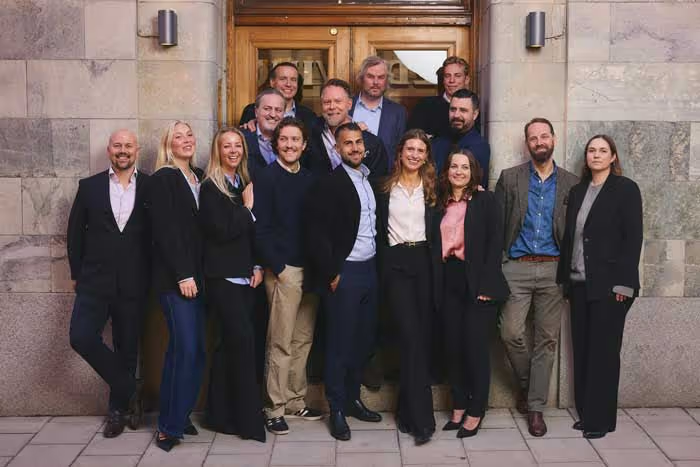
With Community at the Core: Revea’s Growth Journey Continues
April is just around the corner, and as we at Revea look back at the past year, it’s with pride and gratitude. Our growth journey has been nothing short of exceptional. From a handful of dedicated colleagues at the end of last year, we’ve now grown into a fantastic and diverse team.
This expansion has been both exciting and challenging. But despite the rapid pace, we’ve never lost sight of what truly matters to us – our company culture. At Revea, we believe that real success is about much more than numbers on a page.
More Than Just Growth
To us, company culture, community, and job satisfaction are just as important as financial results. It’s this balance that creates the sustainable success we aim for. When employees thrive and feel valued, the business grows – something we’ve clearly seen over the past year.
We plan to continue our growth journey in the coming year, always with our unique culture at the heart of it. That’s how we build something that lasts.
Want to Join Our Journey?
Are you curious about where we’re headed next? Or maybe you’re the next talent to join our team? Visit our career page or reach out to us – we’d love to tell you more about the exciting opportunities at Revea!
We’re always looking for passionate people who share our values and want to help build something extraordinary.

Establishing an International Presence in Sweden – What You Need to Know
Are you a large foreign company, for example in the construction sector, considering establishing operations in Sweden? Navigating Swedish legislation and its extensive tax system can be overwhelming. Below is an overview of key steps and rules to know before starting your operations. Note that requirements may vary depending on the scope and type of business.
At Revea, we are an accounting and auditing firm in Stockholm that helps both Swedish and foreign entities daily with accounting, auditing, tax issues, payroll management, and financial advisory. Feel free to get in touch if you need support or advice on any of the topics below.
Income Tax Liability
A first step for foreign companies is to determine the type of tax liability:
- Legal Entities (foreign companies): Have limited tax liability in Sweden, meaning tax is only levied on income from operations or a permanent establishment in Sweden.
- Individuals (sole proprietors): Generally have limited tax liability as long as they are not residents or permanently present in Sweden. If you move here and register, you become unlimitedly tax liable, meaning all income – both Swedish and foreign – is taxed in Sweden.
If your company is only temporarily or partially present, you might sometimes avoid certain taxes thanks to international tax treaties. It is wise to always check the applicable double taxation agreements between Sweden and your home country.
Limited vs. Unlimited Tax Liability – Summary Table
<table>
<thead>
<tr>
<th>Type of tax liability</th>
<th>Scope of taxation</th>
<th>Who does it apply to?</th>
</tr>
</thead>
<tbody>
<tr>
<td>Limited tax liability</td>
<td>Tax on income from Swedish activities</td>
<td>Foreign legal persons and natural persons not resident in Sweden or residing here for short periods</td>
</tr>
<tr>
<td>Unlimited tax liability</td>
<td>Tax on all income (both Swedish and foreign)</td>
<td>Natural persons residing in Sweden or permanently residing here</td>
</tr>
</tbody>
</table>
<hr />
Registration with the Tax Agency
A foreign company operating in Sweden may need to register for:
- F-tax (F-tax certificate)
- VAT
- Employer Contributions
- Preliminary Income Tax
This applies whether you are a legal entity (e.g., a limited company) or an individual (sole proprietor). To apply, you typically submit form SKV 4632 (Business Registration) or register online via verksamt.se – a joint platform run by the Tax Agency, the Companies Registration Office, and the Agency for Economic and Regional Growth. If you are a foreign company without a Swedish contact person with a Swedish personal number, you may need to submit your application directly to the Tax Agency’s foreign affairs department.
Identification Number and Branch Registration
- Swedish Organizational Number: The Tax Agency assigns a unique organizational number upon registration.
- Branch: If you establish a branch in Sweden, first contact the Companies Registration Office to determine if branch registration is required. You will then receive an organizational number directly from them.
<hr />
Preliminary Tax Declaration (PD) and Monthly Prepayments
Companies with tax liability in Sweden usually pay prepayment tax during the income year. You submit a preliminary tax declaration to the Tax Agency, which estimates your expected tax and sets monthly payments.
- Annual Income Declaration: After the income year, you submit an annual income declaration (e.g., by May 2 for legal entities) when your final tax is calculated.
- Adjustments During the Year: If circumstances change, you can submit a new preliminary tax declaration to adjust your monthly payments.
Tip: Monitor your business results continuously to avoid large outstanding taxes or overpayments.
<hr />
Annual Income Declaration
A foreign company with tax liability in Sweden must submit its annual income declaration.
- Legal Entities (similar to Swedish limited companies): Typically by May 2 of the year following the income year.
- Individuals (residing abroad): By May 31 of the year following the income year (this may vary if an individual becomes unlimitedly tax liable and registers).
In these declarations, you report your accounting results, deductions, and the preliminary tax paid.
<hr />
Social Contributions and Withholding Tax
1. Salary for Work in Sweden
- Permanent Establishment in Sweden: If you have a permanent establishment, you are considered a Swedish employer and must pay employer contributions and withhold preliminary tax (withholding tax) on salaries paid in Sweden.
- No Permanent Establishment: If you lack a permanent establishment, you generally do not withhold tax but may still be liable for social contributions on work performed in Sweden. In such cases, the employee reports their income through a preliminary self-declaration (SA tax).
2. Social Security and A1 Certificate
EU legislation and social security agreements between countries can affect where employer contributions are paid. If an employee is seconded to Sweden for a short period (e.g., less than 24 months) and holds an A1 certificate from their home country, you can often avoid paying Swedish employer contributions.
Checklist for Seconded Employees:
- Secure an A1 Certificate (or equivalent under bilateral agreements) from the relevant authority in the home country.
- Keep Copies of the certificates in your personnel records.
- Contact the Swedish Social Insurance Agency (Försäkringskassan) if unsure about the applicable rules.
3. Prepayment for Income Tax (Withholding Tax)
- SINK (Special Income Tax for Non-Residents): If employees stay in Sweden for less than 6 months, they may sometimes be taxed under SINK – a final withholding tax of 25% without deductions.
- Regular Income Tax: If the stay exceeds 6 months, or if the employee becomes a permanent resident, regular Swedish income tax applies according to tax tables.
<hr />
VAT (Value Added Tax)
A "foreign entrepreneur" under VAT law is a business that lacks a permanent establishment in Sweden. VAT registration may still be required if:
- You sell goods or services to private individuals in Sweden.
- You conduct VAT-liable activities in Sweden and are not covered by reverse charge (where the buyer would otherwise pay the VAT).
In many cases, you can voluntarily register for VAT. This can be advantageous if you frequently make purchases in Sweden and wish to deduct input VAT.
<hr />
F-tax Certificate (Approval for F-tax)
Why is the F-tax certificate important?
- It demonstrates that you are responsible for your own tax and social contributions on payments for work performed.
- The client does not need to withhold tax or pay employer contributions on invoices from you if you have an F-tax certificate.
A foreign company can obtain F-tax even if not all income is taxed in Sweden. However, you may need to provide evidence of your tax history and that you have no outstanding tax debts in your home country. Sometimes, a certificate from the tax authorities in your home country is also required.
<hr />
Deregistration and Changes to Company Information
When you cease operations in Sweden or make significant changes (e.g., change of address or representative), it is important to notify the Tax Agency and, if applicable, the Companies Registration Office.
- Deregistration: Done using form SKV 4639 or electronically via verksamt.se.
- Changes: You may need to submit a new preliminary tax declaration to adjust your prepayment tax if business activity decreases or ceases.
Failure to deregister when ceasing to file declarations may result in fees and estimated tax assessments from the Tax Agency.
<hr />
Get Help from Revea – Your Financial Partner in Sweden
Establishing a business in Sweden can be complex, especially regarding tax matters, accounting, and employer responsibilities. Our consultants at Revea in Stockholm have extensive experience helping foreign companies – particularly in the construction sector – meet all financial and legal requirements.
- Accounting and Financial Statements: We handle ongoing accounting, financial statements, and annual reports in accordance with Swedish standards.
- Auditing and Quality Assurance: Our authorized auditing team supports you with statutory audits and internal controls.
- Tax and Legal Advisory: We guide you through income tax, SINK, VAT, employer contributions, and double taxation treaties.
- Payroll Management and Personnel: We take care of payroll, tax deductions, and social contributions so you can focus on your core business.
Want a reliable partner to guide you through Swedish regulations, handle necessary registrations, and ensure everything is set up correctly from day one? Contact us at Revea – we’re happy to explain how we can help your company successfully establish itself in Sweden.
<hr />
Contact Us
Do you have questions about taxes, declarations, or any other aspect of establishing your business in Sweden?
Feel free to contact us at Revea for a no-obligation discussion and quote. We help you save time, reduce risks, and ensure a smooth start in the Swedish market.
Phone: +46 (0)8 20 31 87
Email: info@revea.se

Rules Regarding Remuneration for Board Members – What Are the Regulations Really?
Serving on a company board often entails significant responsibility and extensive work. The board makes key business decisions, oversees the company’s finances, and is responsible for ensuring that the company complies with applicable laws and regulations. But how does the remuneration for this role work – and what should you consider when paying or receiving board fees?
1. Personal Assignment or Corporate Assignment?
The main rule is that board fees are treated as personal remuneration. This means that the fee recipient normally reports the payment as employment income, and the company is responsible for paying employer contributions. Invoicing the board fee through your own company is only possible in exceptional cases and requires that the assignment is not considered personal in legal terms. In practice, these exceptions are quite narrow, so it is important to ensure that all formal requirements are met before invoicing via another company.
2. Tax Rules and Social Security Contributions
Since board fees are often classified as employment income, both preliminary tax and employer contributions must be reported and paid to the Tax Agency. In turn, the board member receives a payslip similar to that of an employee. To avoid unnecessary tax conflicts, it is wise to:
- Ensure that the board fee decision is documented in the company – for example, in the annual meeting minutes or a specific agreement.
- Clarify whether the fee recipient is considered an employee or not – if the board member also has an employment contract with the company, it is necessary to clarify the overall compensation package.
3. Size and Assessment of the Fee
There are no statutory minimum or maximum amounts for board fees in private companies. Often, the company’s size, complexity, and financial situation serve as the basis for determining the fee. For larger, listed companies, the fee may also reflect the risk and responsibility assumed by the board member. Although there are no precise rules regarding the amounts, recommendations and guidelines (for example, from industry organizations) provide guidance for a reasonable level.
4. Division Between Fixed and Variable Components
Some companies choose to split the fee into a fixed part and a variable part, linked to the company’s performance. However, this can create tax challenges, as board fees are often considered a fixed remuneration for ongoing board assignments. If you are considering a variable component, it is advisable to consult an expert to ensure it is handled correctly for tax purposes.
5. Documentation and Transparency
Regardless of the fee structure, clear documentation is essential. Always record the board’s decision on the fee and ensure it complies with the company’s articles of association and relevant meeting resolutions. A transparent and well-documented process minimizes the risk of future inquiries from auditors, the Tax Agency, or other stakeholders.
In summary, there are two key aspects to consider regarding board fees: how the remuneration is classified (as employment income or not) and that the fee decisions are properly documented. The rules can be complex and are updated regularly, so it is wise to seek expert advice to get it right from the start.
Do you have questions about board fees or other financial matters? Contact us at Revea for assistance with accounting, auditing, tax issues, payroll management, or financial advisory. We help you navigate the regulations correctly and ensure that you and your company comply with the applicable rules.

Important Things to Consider Before the Annual Accounts
The annual accounts are a central part of closing a financial year, and it is crucial to complete them correctly to avoid unnecessary issues and ensure that the company meets its obligations. Here are some key points to keep in mind:
1. Reconcile the Accounting Records
Before starting the year-end closing, ensure that all accounting records are in order. Verify that all business transactions have been recorded and that there are no unclear or missing entries.
2. Correct Any Errors
Review and rectify any mistakes in the accounting records. Check that balances in items such as accounts receivable and payable match reality.
3. Reconcile Balance Sheet Accounts
Ensure that the balance sheet accounts are accurate by comparing them with supporting documents such as bank statements, receivables, and payables. Any discrepancies must be resolved before finalizing the accounts.
4. Inventory the Stock
If your company holds inventory, it is important to perform a stocktake at the time of closing the books. This ensures that the inventory value in the balance sheet is correct and that any necessary adjustments are made.
5. Prepare the Annual Report
If your company is a limited company, an annual report is required to meet statutory requirements. Ensure that the report is clear, accurate, and provides a true and fair view of the company’s financial position.
6. Seek Assistance if Needed
The year-end closing process can be complex, especially for larger companies or if there have been many transactions during the year. A qualified accountant or auditor can help ensure everything is done correctly from the start.
Proper preparation for the year-end closing not only saves time but also reduces the risk of errors and subsequent adjustments. If you need support with your annual accounts, do not hesitate to contact us at Revea. We assist with everything from accounting and auditing to tax advice and financial planning.
Get in touch, and we’ll review your situation together!

New tax and pension rules 2025: What you need to know
In 2025, several changes will come into effect that affect taxes for both wage earners and pensioners. The new rules are designed to create economic incentives for work and improve financial conditions for older people. Here are the key updates:
Tax Relief for Work and Pension
1. Enhanced Earned Income Tax Credit
From 2025, the earned income tax credit and the increased basic deduction will no longer decrease with higher incomes, resulting in lower marginal tax for high-income earners.
2. Lower Tax for Older Employees
Wage earners who turn 67 during the income year will pay only 8% tax on employment income up to 342,000 SEK, including the increased basic deduction and the enhanced tax credit.
3. Increased Basic Deduction for Pensioners
Pensioners aged 67 or older will pay significantly lower taxes. The difference in net income may amount to about 1,900 SEK per month compared to younger pensioners, thanks to the higher basic deduction.
Economic Benefits of Working Longer
Continuing to work after age 66 offers several benefits:
- Higher Pension
Every additional 10,000 SEK in annual income increases the future pension by about 110 SEK per year for life. - Lower Employer Contributions
Employers pay only the age pension fee (10.21%) for employees who turn 67, compared to 31.42% for younger workers.
Tax on Pension and Combined Income
Combining pension with work provides a more favorable tax outcome, especially after age 67. However, if the income is high, state income tax may apply. To avoid this, you can:
- Reduce the Proportion of Pension Withdrawals
Withdrawing less of your public pension reduces the risk of exceeding the threshold for state income tax. - Use the Tax Agency’s Tools
Run a preliminary tax calculation to optimize the balance between salary and pension.
Key Thresholds for 2025
- State Income Tax
A 20% tax is levied on taxable income above 625,800 SEK, regardless of age. - Earning Cap for Pension Rights
The maximum pensionable income is 604,500 SEK.
Plan for a Better Pension
Working longer and delaying pension withdrawals offer significant financial benefits through both a higher pension and lower taxes. Want to know how your situation will be affected? Contact Revea for advice on accounting, tax, and pension!
Have questions about how the new rules affect you? Get in touch with Revea – we’re here to help you navigate financial matters!

Welcome to Revea!
Enter Redvisning has now become part of Revea — a full-service agency with the same personal service, the same contact persons and the same services as before. The only thing that is new is the name and that we now have even more colleagues to collaborate with.
With us, you will receive continued help with everything from accounting and financial statements to payroll management, auditing and consulting.
Do you have questions or want to get in touch with us? Welcome to hear from you — we are here for you just as usual.
You can find us at Gamla Brogatan 32 in Stockholm
Feel free to contact us via contact form or call us directly at the same number as before, 08-678 18 40.